



The Problem We Solve
Most enterprises sit on the same three problems: a legacy stack that slows every release, a backlog of bespoke features the business needs yesterday, and a digital transformation roadmap that stalls at the pilot stage. Generic IT vendors layer more people on the problem; we replace cost with code written, reviewed, and tested by AI-native teams.
Our AI Driven Digitalisation practice exists to do three things, in any order you need them: modernise what is old, build what is missing, and transform how the business operates around it.

Three practices. One delivery model. Picked and sequenced around the outcome you need first.
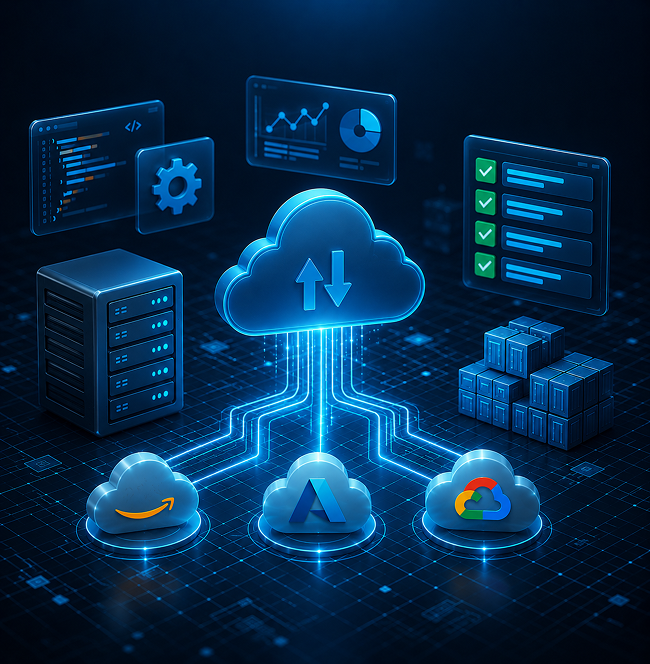
Aging codebases drain budget, slow releases, and lock you out of the cloud. We use Claude to read, refactor, and rebuild legacy applications into cloud-native architectures with full test coverage generated alongside the code. Average time-to-modernise drops by 50% compared to traditional vendors.
- Codebase analysis, dependency mapping, and risk scoring in days, not weeks.
- Refactor monoliths to microservices or modular monoliths your choice, our recommendation.
- Cloud-native targets: AWS, Azure, GCP. Containerised, observability built-in.
- Test suites generated and validated by Claude alongside human review.
When the business asks for a workflow no SaaS will ship, we build it. Our bespoke development practice runs on AI-native pair programming every engineer is paired with Claude, Copilot, or Cursor depending on the task which is how we deliver fully-featured applications in weeks, not quarters.
- Domain-driven design workshops in week one.
- AI-pair-programmed sprints with weekly demos and demoable increments.
- Outcome-based contracts available for scoped builds.
- Production-ready: CI/CD, security, accessibility, and observability - not after-thoughts.
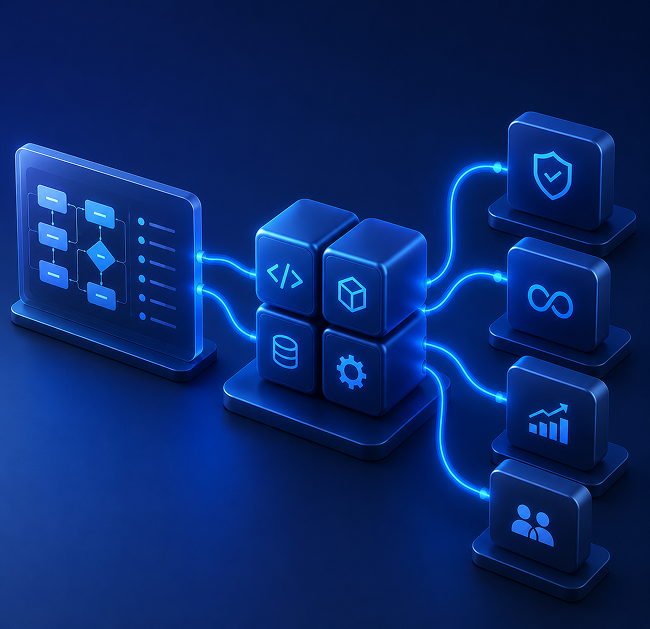

Transformation that does not produce a P&L impact is not transformation. We start with the business outcome cycle time, cost per transaction, customer lifetime value then re-engineer process, technology, and data around it. AI is a means, not a message.
- Tech stack and integration audit before any build.
- Change-management framework alongside the technical work.
- KPI-anchored roadmap with quarterly milestones.
- Co-delivery: SMI builds, your team operates, knowledge transfers as we go.
The goalposts have moved. Digital transformation is no longer about moving spreadsheets to the cloud it is about embedding intelligent tools like generative AI and predictive analytics directly into the way work gets done, decisions get made, and customers get served.
Three forces make this non-negotiable right now:

Leaner competitors and well-funded startups are using operational data to move faster, price sharper, and serve better. Organisations that delay modernisation do not stand still they fall behind.

Consumers and enterprise buyers alike expect seamless, omnichannel experiences. Meeting that bar requires continuous backend modernisation not a one-time project.

Transformative architecture gives organisations the agility to navigate supply disruptions, regulatory shifts, and market volatility without rebuilding from scratch each time.
Whether you are assessing your current state or ccelerating an existing roadmap, we bring structure to every stage.

Deploying AI assistants without discipline creates noise, cost overruns, and inconsistent output. We have built a structured operating model around five engineering principles that determine how our teams use Claude, Copilot, and Cursor in practice.
We treat context windows as a constrained resource. Prompts are engineered to be precise and outcome-focused stripping noise, pre-compressing efference material, and structuring inputs so the model spends tokens reasoning, not re-reading.
Not every task needs the most powerful model. We route requests intelligently complex architecture and multi-step reasoning go to frontier-class models; repetitive generation, boilerplate, and test scaffolding route to faster, lower-cost models. The result is higher throughput at materially lower inference cost.
Our engineers work from structured specifications not open-ended prompts. Feature requirements, API contracts, and domain rules are codified before any generation begins. This grounds outputs in project reality and eliminates the drift that comes from vague, conversational prompting at scale.
Repeatable tasks scaffolding, linting, migration patterns, test generation are codified as reusable agent skills with prompt caching enabled. Teams do not rebuild context on every run. Shared knowledge is retained, compounding efficiency across sprints and projects.
Every AI assistant interaction sits inside a controlled environment policy guardrails, output review gates, and audit trails included. We define what models can and cannot do within each project context, ensuring compliance, IP protection, and consistent quality without slowing engineers down.
Pick the model that fits your budget, risk profile, and roadmap maturity.
Same delivery team
across all four.

You define the KPI; we carry the
execution risk. Ideal for funded
transformation programmed.

engagement for exploratory or
evolving work.

Build-Operate-Manage, Build operate Transfer, or productivity On- Demand pods. Specialist teams stood up in 4 weeks.
