




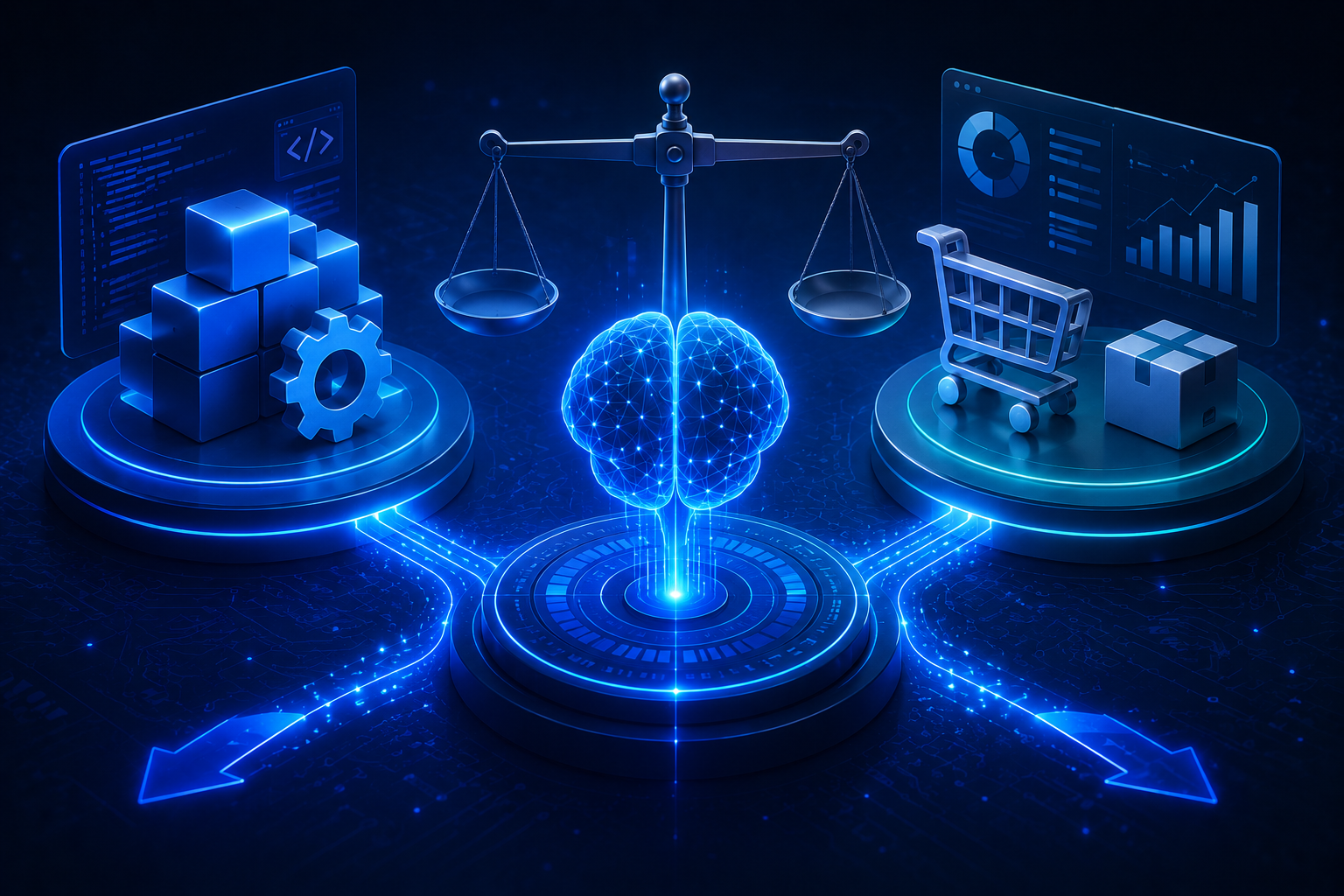
As enterprise AI adoption accelerates, every organization eventually faces the same strategic question: Should we build our own AI capabilities or invest in an existing AI solution?
There isn’t a one-size-fits-all answer. The right approach depends on your business objectives, the complexity of your processes, the sensitivity of your data, and how quickly you need to deploy AI into production.
Many organizations approach this as a simple build-versus-buy decision. In reality, enterprise AI introduces several additional considerations that traditional software procurement frameworks fail to address. The most successful organizations evaluate AI based on long-term business value rather than short-term implementation costs.
Whether you’re exploring Generative AI solutions, implementing AI-driven digitalisation, or accelerating your digital transformation strategy, choosing the right implementation model is critical for long-term success.
Why Traditional Build vs Buy Thinking Falls Short
Historically, enterprise software decisions have been straightforward:
- Build software when it creates competitive advantage.
- Buy software when the capability is standardized across industries.
While this model works well for ERP systems, CRM platforms, HR software, and collaboration tools, AI introduces an entirely different set of considerations.
Unlike conventional software, AI systems continuously learn, adapt, and make decisions based on business data. Their effectiveness depends heavily on how well they understand your organization, your processes, and your operational context.
As a result, enterprises should evaluate AI investments across four key dimensions:
1. Data Sensitivity
Many enterprise AI applications work with highly confidential business information such as financial records, customer data, operational metrics, contracts, or intellectual property.
If sensitive information cannot leave your secure environment due to regulatory or governance requirements, a fully managed third-party AI platform may not be the best fit.
2. Business-Specific Intelligence
The more specialized your business processes become, the less effective generic AI products typically are.
Industry-specific document classification, operational forecasting, engineering workflows, or intelligent process automation often require AI systems trained around your own organizational knowledge.
Organizations increasingly combine enterprise knowledge with Retrieval-Augmented Generation (RAG) to deliver highly accurate responses without exposing proprietary information.
Key Factors That Influence the Build vs Buy Decision
Integration Requirements
AI rarely delivers value as a standalone application. Instead, it becomes valuable when integrated into existing enterprise workflows.
Modern AI solutions frequently need to:
- Read information from ERP systems
- Update CRM records
- Retrieve enterprise documents
- Generate reports
- Trigger business workflows
- Connect with internal APIs
Deep workflow integration often requires custom engineering that off-the-shelf AI platforms cannot provide without extensive customization.
Organizations investing in AI-centric bespoke development can tailor AI capabilities around their unique operational requirements while maintaining flexibility for future enhancements.
Building Internal AI Expertise
Developing AI internally provides benefits beyond the technology itself.
Each implementation strengthens your organization’s expertise in prompt engineering, governance, workflow orchestration, model evaluation, and enterprise AI architecture. Over time, this knowledge becomes a strategic capability that competitors cannot easily replicate.
On the other hand, organizations relying entirely on third-party platforms often become dependent on vendor roadmaps, licensing models, pricing changes, and feature availability.
When Buying an AI Solution Makes Sense
Purchasing an existing AI solution is often the fastest way to begin realizing business value, especially when the capability does not directly differentiate your organization.
Buying is generally the better option when:
- AI supports general productivity rather than core operations.
- You need rapid deployment with minimal development effort.
- The vendor already possesses industry-specific AI expertise.
- The project is intended as a proof of concept before larger investments.
- The business process is standardized across industries.
Examples include:
- Email assistants
- Meeting summarization tools
- Knowledge search
- Document drafting
- Developer productivity tools such as AI Copilot solutions
While commercial AI products reduce implementation time, organizations should always evaluate long-term considerations such as pricing changes, vendor lock-in, API limitations, and future migration costs before making strategic investments.
When Building an AI Solution Is the Better Choice
While commercial AI platforms can accelerate deployment, building a custom AI solution becomes the preferred approach when artificial intelligence is central to your competitive advantage or business operations.
Organizations that choose to build their own AI capabilities gain greater control over data, integrations, security, and future scalability. This approach is particularly valuable for businesses with unique workflows that cannot be effectively addressed using off-the-shelf solutions.
Building an AI solution is often the right decision when:
- Your AI solution relies on sensitive or proprietary business data that must remain within your infrastructure.
- Your business processes create a competitive advantage that cannot be replicated using generic AI products.
- You require deep integration with ERP, CRM, finance, HR, or other enterprise applications.
- Your organization has a long-term AI roadmap and wants to build reusable capabilities for future innovation.
For many enterprises, custom AI development is not simply about technology-it is about creating intelligent systems that become part of their core business operations.
Organizations pursuing AI-Centric Bespoke Development can design AI applications that align with their unique workflows, governance policies, and operational objectives while maintaining complete ownership of their intellectual property.
The Challenges of Building AI
Although building AI offers greater flexibility, it also requires a significant investment in time, expertise, and ongoing maintenance.
Successful AI implementations demand capabilities such as:
- Model selection and evaluation
- Prompt engineering
- Enterprise data preparation
- Workflow orchestration
- API development and integration
- Continuous monitoring and governance
- Performance optimization
Organizations that underestimate these requirements often experience longer implementation timelines, increased costs, and lower-than-expected business outcomes.
Working with experienced AI specialists helps reduce implementation risks while accelerating production-ready deployments.
The Third Option: Build on a Foundation
For most enterprises, the decision is not simply “build” or “buy.” The most effective strategy is often to build on a proven AI foundation.
This approach combines the strengths of leading Large Language Models (LLMs) with enterprise-specific capabilities built around your business.
Rather than developing foundational AI models from scratch, organizations leverage existing LLM technologies while creating customized enterprise capabilities such as:
- Knowledge retrieval using Retrieval-Augmented Generation (RAG)
- Business process orchestration
- Workflow automation
- Security guardrails
- Role-based access controls
- Enterprise system integrations
- Business-specific decision logic
This hybrid model provides the flexibility of custom development while significantly reducing implementation time and development costs.
Combined with Generative AI Services, enterprises can rapidly deploy intelligent business solutions without sacrificing governance, scalability, or customization.
A Practical Framework for Making the Right AI Decision
Instead of asking whether you should build or buy AI, evaluate every use case using four strategic questions.
1. Does This Capability Differentiate Your Business?
If the AI capability directly contributes to your competitive advantage or operational excellence, investing in a custom solution is usually the better long-term choice.
2. How Sensitive Is the Data?
Applications handling confidential financial records, customer information, healthcare data, or proprietary business knowledge often require greater control over infrastructure and governance.
3. How Deep Are the Required Integrations?
Simple AI tools that provide read-only functionality may work well as commercial products. However, AI solutions that must interact with multiple enterprise systems, automate workflows, or trigger business events generally require customized implementation.
4. How Quickly Do You Need Results?
- Immediate deployment (within 60 days): Buying an existing AI solution is often the fastest path.
- Medium-term implementation (3-6 months): Building on an enterprise AI foundation provides an excellent balance of speed and flexibility.
- Long-term strategic capability: Developing a fully customized AI platform delivers maximum business value over time.
Building a Sustainable Enterprise AI Strategy
The build-versus-buy decision should not be viewed as a one-time technology choice. Enterprise AI evolves rapidly, requiring organizations to continuously evaluate emerging technologies, changing business priorities, and new opportunities for automation.
Successful enterprises establish AI governance frameworks that regularly assess:
- Which capabilities should be built internally.
- Which commercial solutions should be adopted.
- Which existing tools should be enhanced or replaced.
- How AI investments align with long-term business goals.
As organizations advance their digital transformation initiatives, maintaining a balanced AI portfolio enables them to combine commercial innovation with proprietary competitive advantages.
Conclusion
There is no universal answer to the build-versus-buy debate. The most effective enterprise AI strategies combine both approaches, selecting the right implementation model for each business capability.
Commodity AI functions can often be purchased to accelerate deployment, while mission-critical capabilities benefit from customized development or foundation-based architectures.
Organizations that approach AI as a strategic portfolio rather than a collection of isolated projects are better positioned to maximize innovation, improve operational efficiency, and create sustainable competitive advantage.
Whether your goal is to implement enterprise automation, deploy intelligent business applications, or build scalable AI solutions, SMI TECHSOLUTIONS helps organizations accelerate innovation through AI-Driven Digitalisation, Generative AI Services, and enterprise-grade custom AI solutions tailored to your business needs.