




Every enterprise engineering leader faces the same recurring pressure: more delivery is expected, and the traditional answer – hire more people – has become slower, costlier, and less certain to produce the capacity actually needed. Recruitment timelines stretch for months. Onboarding takes longer still. And by the time a traditionally staffed team reaches full productivity, the priorities that justified the hire may have already shifted.
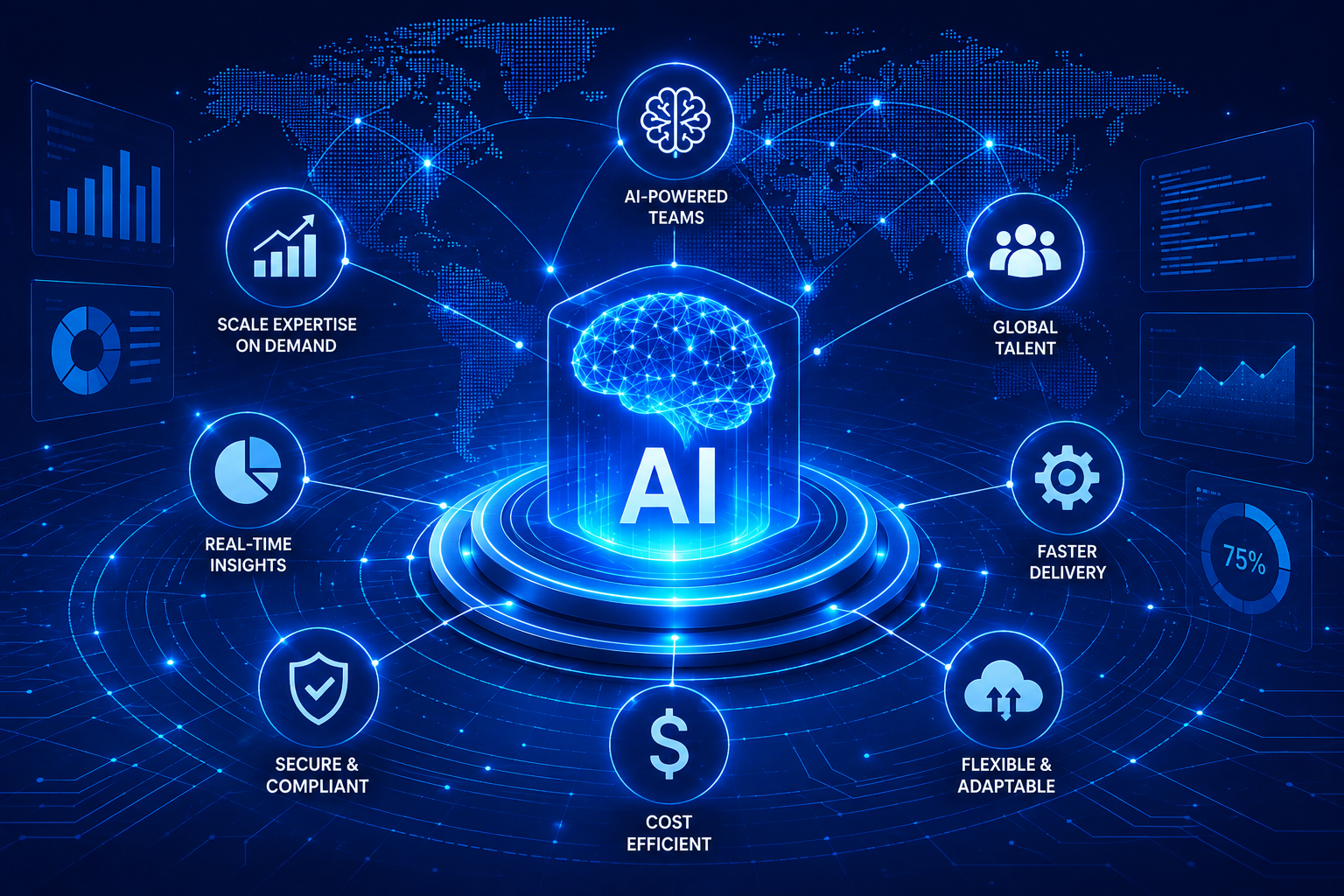
A different model is gaining traction: the AI Remote Team, which combines skilled specialists with AI-native tooling and delivery practices, engaged as flexible capacity rather than permanent headcount. This isn’t traditional outsourcing with an AI label attached – it is a genuinely different delivery model, and understanding why it works requires understanding what’s actually straining the traditional approach.
Why the Traditional Staffing Model Is Under Strain
Three forces are converging to make traditional hiring a slower and riskier answer to capacity problems than it used to be. Specialist technical skills – particularly around AI-native development – are scarce and expensive, and building genuine in-house AI engineering capability from a standing start takes far longer than most delivery timelines allow. Business priorities are shifting faster than annual hiring plans can adapt, leaving enterprises either understaffed against urgent priorities or overstaffed against ones that have since moved on. And the productivity gap between AI-native and traditional engineering practices is widening quickly enough that a newly hired team using conventional methods is already behind the delivery curve on day one.
None of this means headcount growth is obsolete. It means headcount growth alone is an increasingly incomplete answer to a capacity problem that is now as much about method as it is about people.
What Is an AI Remote Team?
An AI Remote Team is a delivery capacity model where an external team of specialists – engineers, data specialists, AI practitioners – works as an extension of your organisation, using AI-native tools and practices as a core part of how they deliver, not as an occasional accelerator. The team integrates into your existing processes and reports into your delivery structure, but brings AI-accelerated velocity and specialist skills your organisation may not need, or want, to build permanently in-house.
This differs from traditional staff augmentation in a specific way: the value isn’t simply additional hands – it is additional hands working at AI-native speed and quality, with the specialist AI engineering expertise to make that speed genuinely reliable rather than a shortcut that creates rework later.
Where AI Remote Teams Deliver the Most Value
- Time-boxed programmes with a hard deadline – where the delivery timeline doesn’t allow for a multi-month traditional hiring and onboarding cycle.
- Specialist AI capability the organisation doesn’t have and doesn’t want to build permanently – where the need is real but not necessarily a permanent addition to the org chart.
- Variable or uncertain capacity needs – where demand for delivery capacity fluctuates in ways that make permanent headcount an inefficient answer.
- Acceleration of an existing internal team – augmenting an existing team’s capacity and AI-native practices, rather than replacing them.
AI Remote Team vs Traditional Staff Augmentation vs Traditional Outsourcing
Traditional staff augmentation adds people to your team, at your existing methods and pace – useful for capacity, but it does not itself close a capability or velocity gap. Traditional outsourcing hands an entire workstream to an external team with limited visibility and control, optimised for cost rather than integration. An AI Remote Team sits between the two: integrated into your team and processes like staff augmentation, but bringing AI-native velocity and specialist capability that traditional staff augmentation doesn’t guarantee, without the reduced control and visibility of full outsourcing.
The distinguishing factor is not the remote or flexible nature of the engagement – it is that AI-native tooling and practice are core to how the team delivers, not an occasional accelerator layered onto conventional methods.
What Enterprises Should Evaluate Before Adopting an AI Remote Team Model
- Is the need genuinely a capacity or timeline problem, rather than a need for a permanent internal capability?
- Does the partner have demonstrable AI-native delivery practice, not just AI-labelled marketing?
- How will the team integrate into your existing processes, tools, and governance?
- What is the plan for knowledge transfer or capability building if the engagement is meant to be temporary?
The Bottom Line
The choice enterprises face is no longer simply build versus buy, or hire versus outsource. It increasingly includes a third option: engage flexible, AI-native delivery capacity that closes both a capacity gap and a velocity gap simultaneously – without the multi-month lead time of traditional hiring or the reduced control of conventional outsourcing.
For enterprises facing delivery pressure that traditional hiring timelines can’t match, an AI Remote Team is worth evaluating as a genuine alternative, not simply a cheaper version of the same staffing decision.
Related Services
Need additional AI-native delivery capacity without committing to permanent headcount? Contact SMI TechSolutions to discuss how an AI Remote Team can support your engineering and delivery goals.