




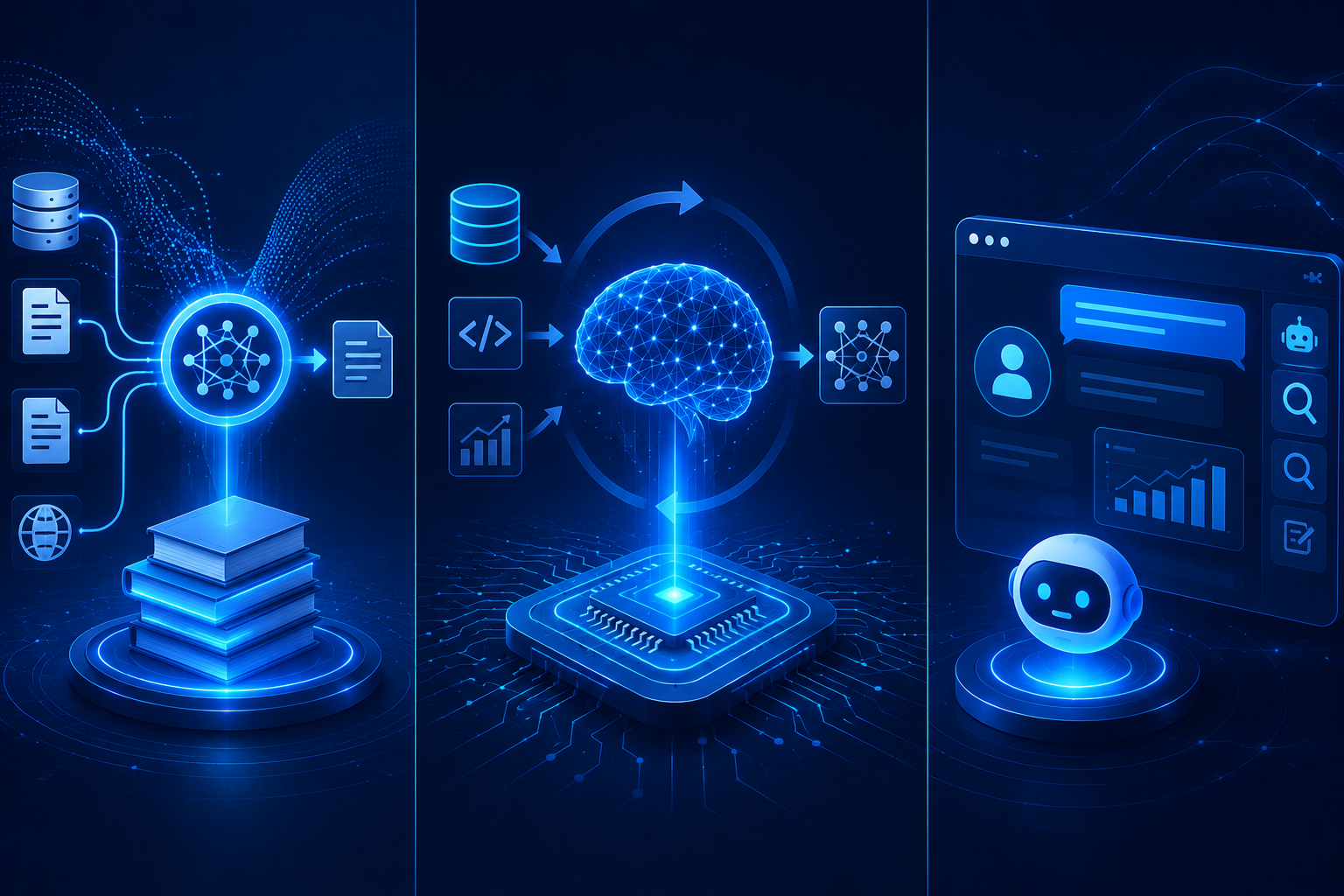
Three terms dominate nearly every enterprise conversation about implementing Gen AI: RAG, fine-tuning, and Copilot. They are frequently discussed as if they were three competing options for the same decision – when in fact only two of them are actually alternatives to each other, and the third is something else entirely. Getting this distinction right changes how enterprises should be evaluating their AI implementation options.
This post draws a precise line between the three, clarifies how they actually relate to each other, and sets out how to choose the right combination for your specific need.
Defining the Terms
What Is RAG (Retrieval-Augmented Generation)?
RAG is a technique for grounding an AI model’s responses in specific, current information – typically your organisation’s own documents and data – by retrieving relevant content at the moment of the query and feeding it to the model alongside the question. The model’s underlying training doesn’t change; instead, it is given the right context to answer accurately from, each time it is asked.
For enterprises looking to implement RAG (Knowledge-Based AI), this approach can provide a practical way to connect AI capabilities with current organisational knowledge.
What Is Fine-Tuning?
Fine-tuning is a technique that adjusts a model’s underlying parameters through additional training on a specific dataset, changing how the model responds by default – its tone, its domain knowledge, its behaviour patterns – without needing that information supplied at query time. Fine-tuning changes the model itself; RAG changes what information the model has access to when answering.
What Is a Copilot?
A Copilot is a delivery pattern, not a technique for grounding AI knowledge. It refers to an AI assistant embedded inside an existing workflow or application, providing contextual assistance for a specific task. A Copilot can be powered by RAG, by a fine-tuned model, by both together, or by neither – the term describes where and how the AI is delivered to the user, not what technique underlies its knowledge or behaviour.
Enterprises evaluating embedded AI assistance can explore Copilot services as a delivery approach for integrating AI directly into existing workflows.
Why Enterprises Confuse the Three
The confusion arises because RAG and fine-tuning are genuinely comparable alternatives – both are techniques for making a general-purpose model behave accurately for your specific context – while Copilot answers an entirely different question: not “how does the model know what it knows,” but “where and how does the user interact with it.” Vendor marketing compounds the confusion by using all three terms together without clarifying which layer of the stack each one operates at.
The practical consequence is enterprises evaluating “RAG versus Copilot” as if they were mutually exclusive choices, when in reality a well-designed Copilot experience is very often built using RAG underneath it – the real decision is RAG versus fine-tuning as the grounding technique, with Copilot as a separate decision about delivery.
RAG vs Fine-Tuning: Side-by-Side Comparison
| Dimension | RAG | Fine-Tuning |
|---|---|---|
| What it changes | What context the model receives | The model’s underlying behaviour |
| Best suited to | Frequently changing, document-based knowledge | Stable domain tone, style, or behaviour patterns |
| Update speed | Instant – update the source documents | Requires retraining to update |
| Data requirements | Existing documents & structured content | Curated, labelled training examples |
| Transparency | Can cite retrieved sources | Harder to trace why the model responded a certain way |
| Typical cost profile | Lower upfront, ongoing retrieval infrastructure | Higher upfront, lower ongoing infrastructure |
| Typical use case | Enterprise knowledge base, customer support | Domain-specific tone, specialised classification tasks |
The table illustrates the genuine tradeoff between the two techniques: RAG is faster to update and more transparent about its sources, while fine-tuning embeds behaviour directly into the model at the cost of needing retraining whenever that behaviour needs to change. Many production systems use both together – a fine-tuned model for domain tone and reasoning style, grounded further with RAG for current, specific factual content.
Where Copilot Fits: The Delivery Layer, Not the Technique
Once RAG and fine-tuning are understood as alternative (or complementary) techniques for grounding a model, Copilot’s role becomes clearer: it is the interface and workflow layer that determines how users actually experience the AI, regardless of which grounding technique sits underneath it. A Copilot embedded in a CRM might use RAG to answer questions about a specific customer account. A Copilot embedded in a legal document tool might use a fine-tuned model calibrated to the organisation’s specific contract language, alongside RAG for retrieving the current version of a specific clause library.
The decision to build a Copilot experience is therefore a separate decision from the RAG-versus-fine-tuning question – it is about whether the AI capability should live inside an existing workflow (Copilot) or stand alone as its own interface, independent of which grounding technique powers it.
When to Choose Each Approach
Choose RAG when:
- Your knowledge base changes frequently and needs to stay current without retraining.
- Transparency and source citation matter for trust or compliance reasons.
- You need to get a grounded AI capability into production relatively quickly.
Choose fine-tuning when:
- You need consistent tone, style, or reasoning behaviour that doesn’t depend on retrieved documents.
- The task involves specialised classification or pattern recognition better learned through training examples than supplied context.
- The underlying knowledge or behaviour is genuinely stable, not frequently changing.
Build a Copilot experience when:
- Users need AI assistance embedded directly in a tool they already use daily, rather than a separate interface.
- The value depends on the AI seeing the user’s current context – what document they have open, what record they’re viewing.
The Phased Roadmap: Building a Production-Ready Enterprise AI Capability
Phase 1: Establish the Knowledge and Data Foundation (4-6 weeks)
Assess and structure the documents, data, and content that will ground your AI capability, regardless of which technique you ultimately choose. A strong Data Engineering & BI Services foundation can support the data and integration requirements behind these AI capabilities.
Phase 2: Select and Build the Grounding Approach (6-12 weeks)
Implement RAG, fine-tuning, or a combination, based on how frequently your knowledge changes and how much transparency your use case requires.
Phase 3: Design the Delivery Layer (4-8 weeks)
Decide whether the capability should be delivered as a standalone tool or embedded as a Copilot inside an existing workflow, and design the interface accordingly.
Phase 4: Continuous Evaluation and Refinement (ongoing)
Monitor accuracy, retrieval quality, and user adoption, refining the grounding approach and delivery experience as usage patterns and knowledge sources evolve.
Common Pitfalls
- Treating RAG and Copilot as competing choices – comparing a grounding technique against a delivery pattern as if they answered the same question.
- Fine-tuning on knowledge that changes frequently – choosing a technique that requires retraining for content that would be far better served by retrieval.
- Building a Copilot with no grounding strategy underneath it – shipping a well-designed embedded interface that produces ungrounded, unreliable responses because neither RAG nor fine-tuning was properly implemented first.
The Bottom Line
RAG and fine-tuning are genuine alternatives – and often complements – for grounding an AI model in your enterprise’s specific knowledge and behaviour. Copilot is a different kind of decision entirely: where and how that grounded capability reaches your users. Getting this distinction right is the difference between an AI implementation strategy and a collection of vendor buzzwords assembled without a clear architecture.
Related Services
- Gen AI Services
- RAG (Knowledge-Based AI)
- Copilot
- AI-Centric Bespoke Development
- Data Engineering & BI Services
Planning an enterprise Gen AI implementation? Contact SMI TechSolutions to discuss whether RAG, Copilot, fine-tuning, or a combination is right for your use case.