




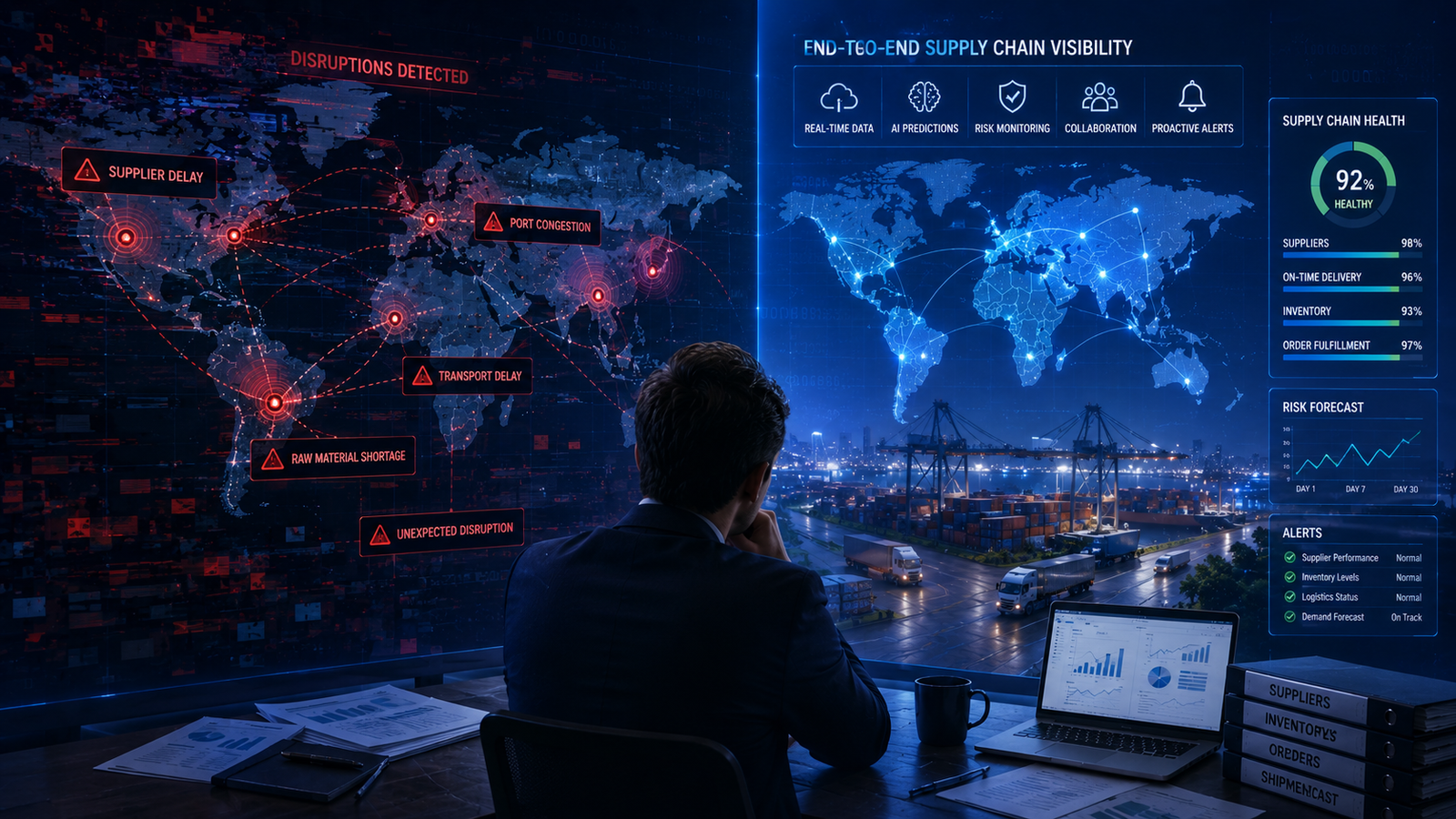
Supply chain visibility initiatives are commissioned after a costly disruption, with a clear mandate: never be caught unaware again. A substantial share of these initiatives deliver a technically functioning supply chain visibility platform that still fails to catch the next disruption early enough to matter – because the underlying failure patterns were never addressed, only the symptom that prompted the investment.
These patterns repeat consistently enough across industries and supply chain structures that they can be anticipated and designed around from the outset.
Here are the five root causes that account for the majority of supply chain visibility initiatives that fail to deliver genuine disruption prevention – and what leaders must do differently.
The Numbers Don’t Lie
A significant proportion of supply chain visibility and control tower initiatives fail to demonstrably reduce disruption impact within their first year, despite functioning as technically designed. The gap between visibility delivered and disruption actually prevented is the defining characteristic of this failure pattern.
The cost compounds beyond the initial investment. A visibility platform that doesn’t genuinely prevent disruption leaves the organisation exposed to the same costly surprises the initiative was meant to eliminate, while the credibility of future supply chain technology investment erodes with each disruption the “visibility” platform failed to catch.
The good news: these failure patterns are well understood and preventable.
Root Cause 1: Visibility Built on Tier-One Data Only
The most damaging and common pattern is building a visibility platform that integrates data only from direct, tier-one suppliers – while the organisation’s most costly disruptions have historically originated from sub-tier suppliers several layers removed from direct contract relationships. The resulting platform provides genuine visibility into exactly the part of the network least likely to be the source of the next major disruption.
The Fix: Map where your most significant past disruptions actually originated before designing the visibility scope. If sub-tier risk is a genuine historical pattern, the platform needs to extend visibility beyond tier-one, even where that requires additional partner engagement effort.
Root Cause 2: No Named Owner for Cross-Functional Response
Visibility platforms surface exceptions and early warning signals – but when no one is explicitly accountable for acting on a specific category of alert, the signal is noted and no coordinated response follows. The disruption still arrives largely unmitigated, despite having been visible in advance.
The Fix: Assign a named, cross-functional owner to each category of risk signal, with a defined response process – not just a dashboard that assumes someone, somewhere, will notice and act.
Root Cause 3: Data Refresh Too Slow, Masquerading as Real-Time
Supply chain visibility platforms are frequently built on EDI feeds and partner data exports that update daily or less often, then marketed internally as “real-time visibility.” For fast-moving disruptions – a logistics delay, a sudden capacity constraint – daily refresh cycles are functionally too slow to enable a preventive response, regardless of how the platform is described.
The Fix: Assess the genuine refresh cadence of every data source honestly, and scope the platform’s capability claims accordingly. Where true real-time integration isn’t achievable for a given source, design the response process around the actual refresh cadence rather than an aspirational one.
Root Cause 4: Underestimating Partner Integration Complexity
Suppliers, carriers, and logistics partners operate on a wide variety of data formats, EDI standards, and system capabilities – and the effort required to achieve consistent, reliable data exchange across a diverse partner base is routinely underestimated during initial scoping, surfacing mid-programme as costly rework and partner-by-partner customisation.
The Fix: Run a structured partner integration assessment before committing to a delivery timeline, understanding the genuine data-sharing capability and willingness of each priority partner – not just the theoretical standard they’re supposed to support.
Root Cause 5: No Connection Between Visibility and Procurement/Planning Action
The final failure pattern is structural. A visibility platform can accurately flag a risk, and the organisation still fails to prevent disruption because there is no defined process connecting that signal to a specific procurement, planning, or logistics action – alternate sourcing, expedited shipping, inventory buffer adjustment. Visibility without a connected action pathway is observation, not prevention.
The Fix: Define, in advance, the specific action that follows from each category of risk signal – and who has the authority to trigger it – so that visibility translates into intervention before disruption occurs, not just awareness after the fact.
The Framework: What Successful Programmes Do Differently
The common thread across all five failure patterns is designing the response process and true data scope around actual historical disruption patterns, rather than building a generic visibility platform and assuming prevention will follow automatically.
Before your programme begins:
- Map where historical disruptions actually originated, including sub-tier supplier risk
- Assess genuine data refresh capability across all planned data sources honestly
- Run a structured partner integration assessment before committing to a delivery timeline
At programme kickoff:
- Assign named, cross-functional owners to each category of risk signal
- Define the specific action that follows from each signal category, and who can trigger it
During delivery:
- Track disruption prevention outcomes, not just platform uptime or data sources connected
- Refine response processes and thresholds based on real disruption events, not launch assumptions
The supply chain visibility initiatives that succeed are not the ones with the most data sources connected. They are the ones scoped to where disruption genuinely originates, with named accountability and a defined action pathway from every signal to a real intervention.
Related Services
- Supply Chain Solutions
- Data Control Tower & Digital Cockpit
- Data Engineering & BI Services
- Data Analytics
- Digital Transformation
Ready to turn supply chain visibility into genuine disruption prevention? Contact SMI TechSolutions to discuss your supply chain visibility and transformation requirements.