




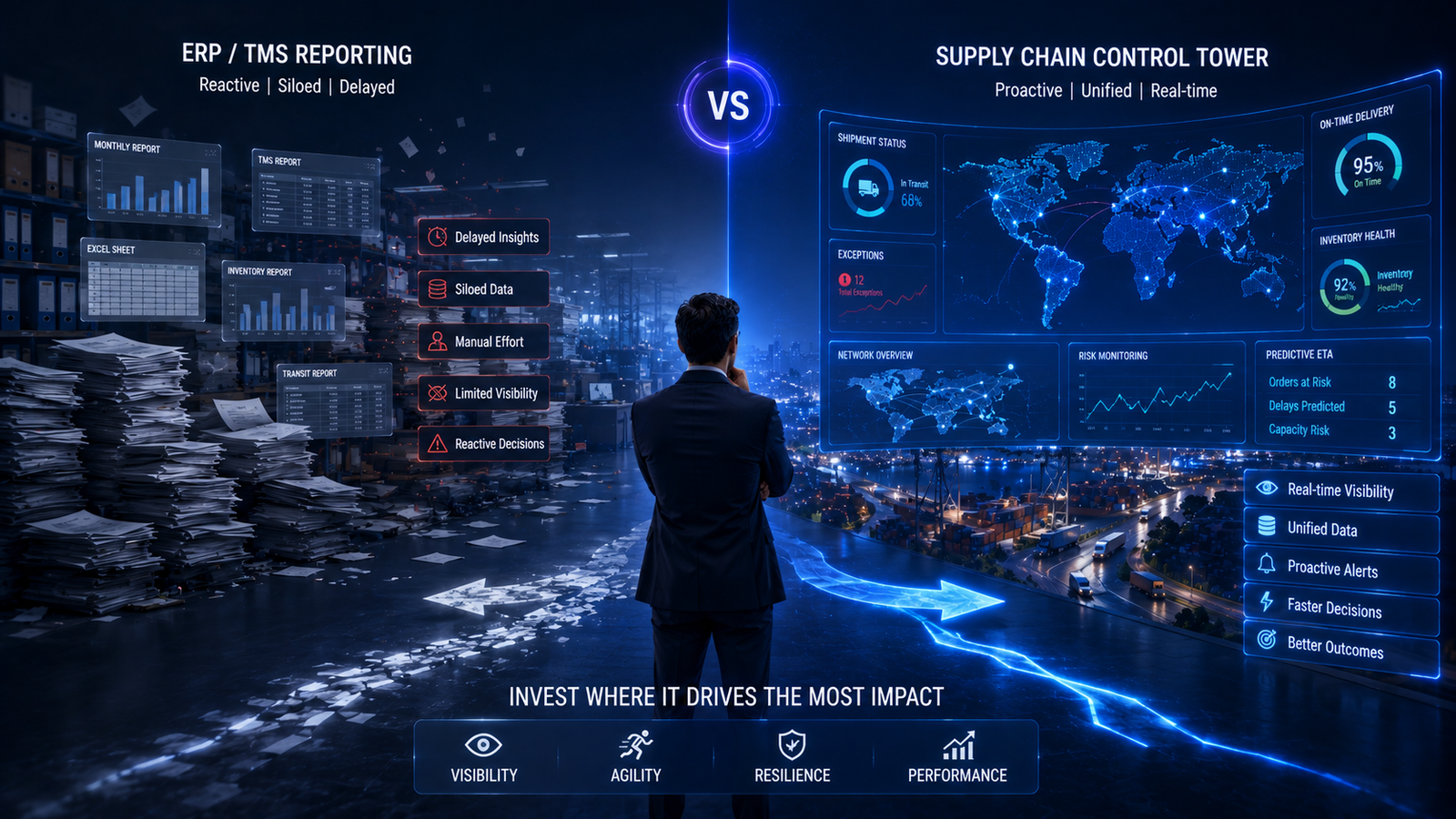
Supply chain leaders evaluating visibility investment routinely face a version of the same question: isn’t the reporting already built into our ERP and transportation management system sufficient, or do we genuinely need a separate control tower? The honest answer depends on what those existing systems can and cannot see – and conflating the two leads either to underinvestment in genuine cross-system visibility, or to an expensive control tower duplicating reporting the ERP already provides adequately.
This post draws a precise line between ERP/TMS reporting and a genuine supply chain control tower, and sets out how to decide where to invest first.
Defining the Terms
What Is ERP/TMS Reporting?
ERP and TMS reporting refers to the native reporting and dashboard capability built into your enterprise resource planning and transportation management systems – order status, inventory levels, shipment tracking, and similar operational reports scoped to the data each system directly manages. This reporting is typically accurate and timely for the specific system it comes from, but limited to that system’s own data.
What Is a Supply Chain Control Tower?
A supply chain control tower is a unified, real-time visibility layer that integrates data across your ERP, TMS, warehouse management systems, and external partner data – suppliers, carriers, third-party logistics providers – into a single cross-system view, with exception alerting designed to surface disruption before it compounds across the network.
Why Organisations Confuse the Two
The confusion arises because ERP and TMS vendors increasingly market their native reporting capability using “visibility” and “control tower” language, and because both genuinely provide operational reporting value. The distinction lies in scope: ERP/TMS reporting shows you what that system knows; a control tower shows you what your entire network – including partners outside your own systems – is doing, correlated together.
The practical risk is organisations investing in enhanced ERP or TMS reporting expecting cross-network visibility it was never designed to provide, or commissioning an expensive control tower to duplicate reporting their existing systems already handle perfectly well.
Side-by-Side Comparison
| Dimension | ERP / TMS Reporting | Supply Chain Control Tower |
|---|---|---|
| Primary objective | Report on data within one system | Unify visibility across systems & partners |
| Data scope | Single system’s own records | Multiple systems plus external partner data |
| Refresh cadence | Typically real-time within the system | Real-time to near-real-time, dependent on partner data |
| Exception detection | Limited to that system’s own thresholds | Cross-system exception detection and alerting |
| Multi-tier visibility | None beyond direct system data | Can extend to sub-tier suppliers and partners |
| Typical timeline | Often already available, minimal build | 2-5 months for an initial priority domain |
| Typical outcome | Accurate operational reporting per system | Network-wide disruption visibility and faster response |
The table illustrates the core distinction: ERP/TMS reporting is accurate but scoped to a single system, while a control tower’s value comes specifically from integrating across systems and partners that ERP/TMS reporting was never designed to see.
When to Rely on ERP/TMS Reporting, When to Build a Control Tower, and When to Do Both
Rely on ERP/TMS reporting when:
- Your visibility need is genuinely scoped to a single system’s data – order status, inventory within one warehouse system
- Disruptions have not historically originated from gaps between systems or from partners outside your direct control
- The reporting cadence and detail already native to your ERP or TMS meets the decision-making need
Build a supply chain control tower when:
- Disruptions have historically originated from gaps between systems, or from sub-tier suppliers and partners your ERP/TMS cannot see
- Cross-functional teams currently assemble a shared picture manually from multiple system exports during disruptions
- The cost of delayed cross-network visibility is high enough to justify dedicated integration investment
Do both when:
- ERP/TMS reporting remains the right tool for system-specific operational detail, while a control tower handles the cross-system and partner correlation those systems cannot provide
- You are building visibility incrementally, starting with what existing systems already handle well before extending into genuine cross-network integration
The Phased Roadmap: Sequencing the Investment
Phase 1: Audit Existing ERP/TMS Reporting Capability (2-3 weeks)
Assess what your existing systems already report accurately and in a timely way, and identify genuine gaps – specifically where visibility needs to cross system or partner boundaries that native reporting cannot reach.
Phase 2: Build the Control Tower for Cross-System Gaps (2-5 months)
Focus control tower investment specifically on the cross-system and partner integration gaps identified in Phase 1 – not on duplicating reporting your ERP or TMS already handles well.
Phase 3: Extend to Priority Sub-Tier Partners (ongoing)
Where sub-tier supplier or partner risk has been a genuine historical disruption source, extend control tower integration to those specific relationships, prioritised by risk rather than attempting comprehensive coverage immediately.
Phase 4: Continuous Refinement (ongoing)
Refine the control tower’s alerting and integration scope as partner relationships, risk patterns, and available data evolve, while maintaining ERP/TMS reporting for the system-specific detail it continues to handle well.
Common Pitfalls
- Duplicating existing ERP/TMS reporting in a new control tower – investing in cross-system integration for data a single system already reports adequately.
- Expecting ERP/TMS reporting to provide cross-network visibility it was never designed for – relying on native system reports to catch disruptions originating from partners or sub-tier suppliers outside that system’s view.
- Building a control tower without auditing existing reporting first – missing the opportunity to scope the investment precisely to genuine gaps rather than a comprehensive, more expensive rebuild.
The Bottom Line
ERP and TMS reporting and a supply chain control tower are not competing investments – they operate at different scopes, and the right supply chain visibility architecture typically uses both together. ERP/TMS reporting remains the right tool for system-specific operational detail; a control tower’s value comes specifically from integrating across systems and partners those native reports cannot reach.
The right starting point is an honest audit of what your existing systems already report well, so control tower investment is scoped precisely to the genuine cross-system and partner visibility gaps that matter most.
Related Services
- Data Control Tower & Digital Cockpit
- Supply Chain Solutions
- Data Engineering & BI Services
- Data Analytics
- Digital Transformation
Looking to determine whether your organisation needs enhanced ERP/TMS reporting or a dedicated control tower? Contact SMI TechSolutions to discuss your supply chain visibility requirements.