




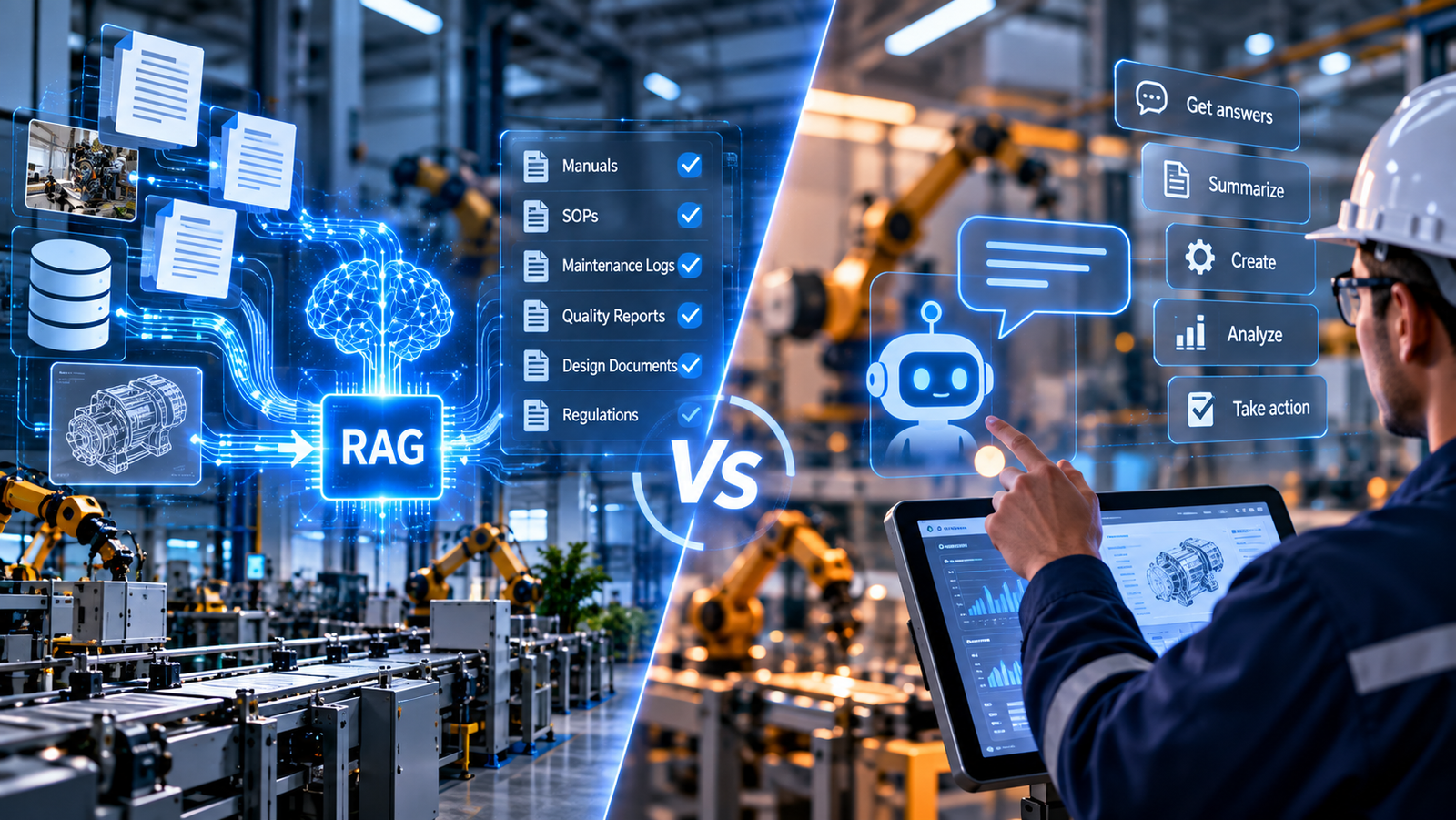
Both get pitched as “Gen AI for manufacturing.” Both can involve the same underlying language models. But RAG (retrieval-augmented generation against your own documentation) and Copilot (an AI assistant embedded in existing tools like Microsoft 365 or engineering software) solve different problems, and manufacturers who treat them as interchangeable options in the same budget line often end up deploying the wrong one for the use case in front of them.
Two Different Jobs
RAG’s job is answering questions accurately from your own verified content – manuals, specs, incident reports – with source citation so the answer can be checked against the original document. Copilot’s job is accelerating work inside tools your teams already use – drafting a report in Word, summarising an email thread, generating a first-pass script in an engineering tool – where the value is speed and a first draft, not verified factual retrieval from your proprietary documentation.
Confusing the two produces predictable disappointment: deploying Copilot and expecting it to give reliably grounded answers about your specific equipment (it wasn’t built to retrieve from your proprietary manuals unless specifically connected to them), or deploying RAG and expecting it to draft general documents the way a general-purpose copilot does (it’s optimised for grounded retrieval, not open-ended drafting).
Side-by-Side Comparison
| Dimension | RAG (Retrieval-Augmented Generation) | Copilot |
|---|---|---|
| What it solves | Accurate answers from your own manuals, specs, and historical documentation | Faster drafting and summarisation inside everyday productivity and engineering tools |
| Typical use case | Technician queries maintenance procedure; engineer checks a historical incident | Drafting a shift report, summarising an email thread, generating a documentation first draft |
| Grounding | Retrieves from your verified, indexed source documents with citations | Draws on general model knowledge plus whatever documents/context you explicitly connect it to |
| Best fit when… | You need verifiable answers from proprietary technical content | You need to speed up general knowledge-work tasks your teams already do in existing tools |
| Deployment effort | Higher upfront – requires document cleanup and indexing | Lower upfront – largely configuration of an existing platform |
| Risk profile | Lower hallucination risk due to grounding, if documentation is clean | Higher risk of generic or ungrounded output on domain-specific technical questions |
| Where it shows up on the floor | Technician-facing query interface, engineering knowledge search | Office and engineering staff drafting, summarising, and reporting tasks |
A Concrete Example of the Confusion
Picture a maintenance engineer asking a Gen AI assistant “what’s the correct torque spec for the bearing housing on Line 4’s press?” If that assistant is a general Copilot without any connection to the plant’s actual specs, it may still generate a plausible-sounding torque value drawn from general manufacturing knowledge – technically coherent, but not necessarily correct for that specific press, that specific bearing housing, or that plant’s specific maintenance revision. If the same question goes to a properly indexed RAG system, it retrieves the actual spec from the plant’s own verified documentation and cites which manual and revision it came from – an answer the engineer can cross-check in seconds.
Now picture the reverse: an office administrator asking a RAG system to “draft a friendly reminder email about the shift schedule change.” A system built purely for grounded technical retrieval may handle this poorly or refuse, because it wasn’t designed for open-ended drafting – precisely the task a general Copilot handles well. Neither system is broken in either scenario; each is being asked to do the job the other was built for.
Decision Criteria
Choose RAG if the core need is accurate answers grounded in your own proprietary manufacturing knowledge – maintenance procedures, historical incidents, engineering specs – where a wrong or ungrounded answer has real operational consequences on the floor.
Choose Copilot if the core need is accelerating general knowledge work your teams already do – reports, emails, documentation drafts, meeting summaries – where speed and a good first draft matter more than retrieval from proprietary technical content, and a human reviews the output before it’s used.
Choose both, scoped separately, if you have both needs – which most mid-size and large manufacturers do. The mistake isn’t wanting both; it’s expecting one to do the other’s job well.
The Business Case
Manufacturers that deploy RAG specifically for technician and engineering knowledge retrieval see 40 to 60 per cent reductions in time spent searching for documentation, with meaningfully lower hallucination-driven errors than manufacturers who tried to stretch a general Copilot deployment to cover the same use case. Manufacturers that deploy Copilot specifically for office and engineering productivity tasks – without expecting it to answer proprietary technical questions – report faster adoption and higher satisfaction than those who deployed it expecting RAG-level grounding on manufacturing-specific content it was never indexed against.
What Happens When These Get Mismatched
The most common mismatch is deploying Copilot and asking it manufacturing-specific technical questions it has no grounding in – it will often still answer, confidently, using general knowledge that may not match your specific equipment, procedures, or historical incidents. This is arguably more dangerous than the system saying “I don’t know,” because the confidence of the answer doesn’t signal its lack of grounding. The second most common mismatch is deploying RAG for general office productivity tasks it wasn’t optimised for, and being frustrated that it doesn’t draft a shift report as fluently as a general-purpose copilot would – a fair complaint, but a scoping error, not a product failure.
What This Costs to Get Wrong
The cost of deploying the wrong tool for a use case isn’t usually visible in a line-item budget – it shows up as quiet abandonment. Engineers who get an ungrounded, occasionally-wrong technical answer from a general Copilot stop asking it manufacturing-specific questions within a few uses, reverting to the old habit of asking a tenured colleague instead – which means the Copilot investment quietly underperforms for exactly the use case it was oversold on. Office staff who try to get a RAG-only system to draft a general document, and find it stiff or poorly suited to open-ended writing, form an early negative impression of “the AI tool,” which can bleed into scepticism about the separate, better-suited RAG deployment for technical retrieval. Getting the scoping right at the outset avoids both failure modes, and avoids one bad first impression poisoning the well for a second, genuinely well-suited use case later.
A Practical Path
Most manufacturers get the best results running both, deliberately scoped: RAG for technician and engineering knowledge retrieval against verified documentation, Copilot for general office and engineering productivity tasks inside existing tools. Where the two overlap – an engineer using Copilot to draft a report that references a specific historical incident – the right architecture connects Copilot to the same underlying, verified RAG index, rather than letting it generate that technical detail from general knowledge alone.
Vendor Claims Worth Scrutinising
Both RAG and Copilot are heavily marketed terms right now, and vendor pitches sometimes blur the distinction to make a single product sound more comprehensive than it is. A useful question to ask any vendor pitching a manufacturing Gen AI solution: when this system answers a question about a specific piece of equipment, is it retrieving that answer from a document you can point to, or generating it from general training knowledge that happens to sound plausible? Vendors who can answer clearly and specifically tend to have genuinely thought through the grounding architecture. Vendors who answer vaguely, or conflate “it uses AI” with “it retrieves from your documents,” are worth a harder look before committing budget – because the gap between those two things is exactly where manufacturing Gen AI pilots run into trouble on the shop floor.
What Doesn’t Change Regardless of Which You Deploy
Two things hold true no matter which tool fits a given use case. First, document and context quality matters in both – a RAG system is only as good as the manuals it indexes, and a Copilot connected to your own documents for grounded answers is only as good as what you’ve chosen to connect it to; neither tool manufactures accuracy out of a vacuum. Second, human review of high-stakes outputs matters in both – an engineer should review a copilot-drafted work instruction before it’s published, just as a technician should be able to verify a RAG-cited procedure against the source if something looks off. The tools differ in what they’re good at generating or retrieving; they don’t differ in needing a human checkpoint before their output drives a real-world action.
Why SMI TECHSOLUTIONS
SMI TECHSOLUTIONS scopes RAG and Copilot deployments separately, against the specific job each is actually good at, rather than selling one Gen AI package that’s expected to do both. Where a use case genuinely needs both – grounded technical retrieval inside a general productivity workflow – we architect the integration deliberately rather than letting scope blur the distinction between the two.
Related Reading
- Gen AI in Manufacturing: The Enterprise Leader’s Complete Guide
- Why Manufacturing Gen AI Pilots Never Make It to the Shop Floor
Related Services
- RAG (Knowledge-Based)
- Copilot
- Generative AI Services
- AI-Centric Bespoke Development
- Manufacturing
- Data Engineering & BI Services
Need Help Choosing Between RAG and Copilot?
Not sure whether your next use case needs RAG, Copilot, or both? Talk to our team to discuss your manufacturing Gen AI requirements.