




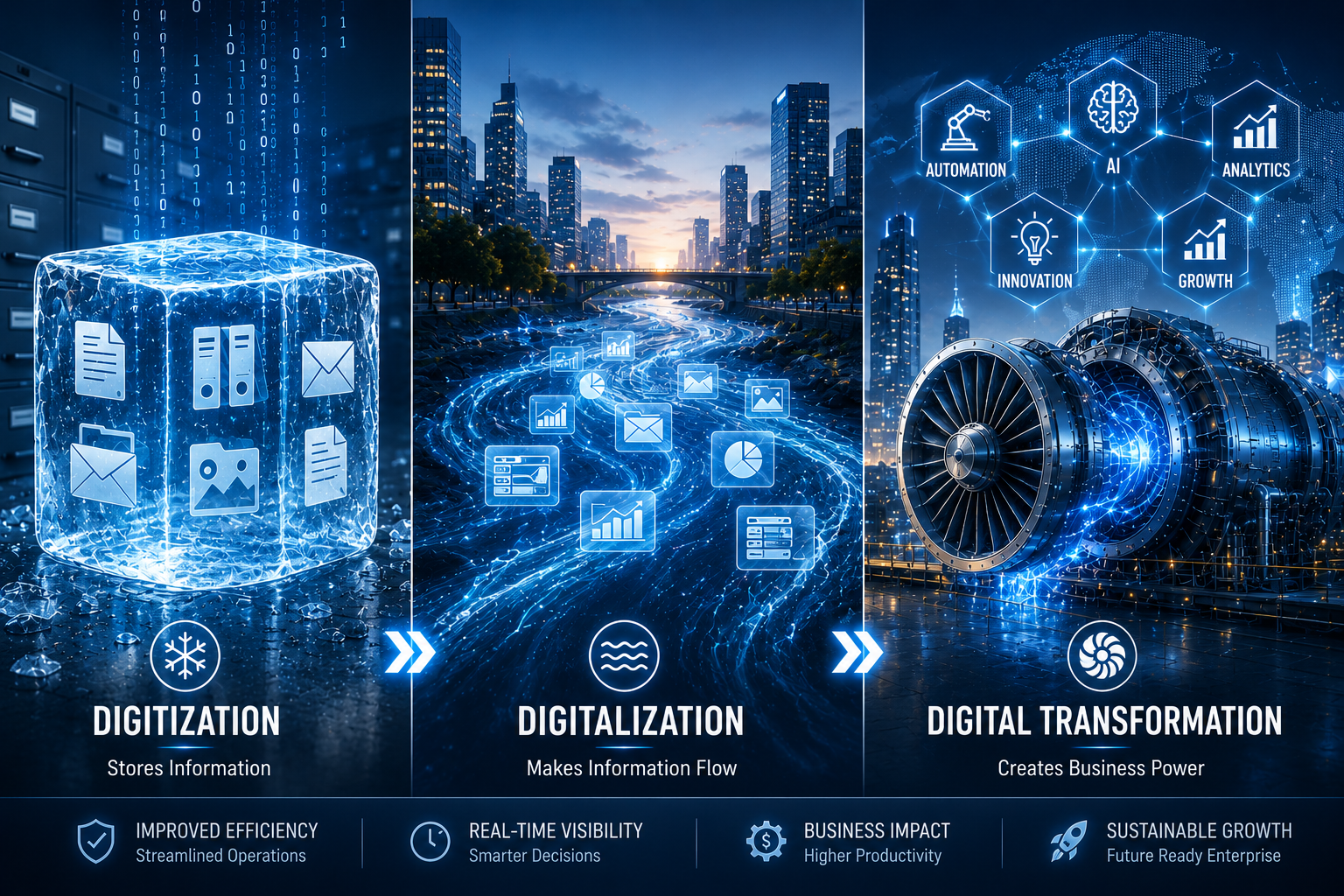
Three terms circulate through nearly every enterprise strategy deck: digitization, digitalization, and digital transformation. They are frequently used as synonyms – sometimes within the same paragraph – despite describing three distinct stages of a maturity path, each with a different scope, different risk profile, and different expected business outcome.
Treating them as interchangeable leads to a specific, costly mistake: enterprises that complete digitization or digitalization work and report it internally as “transformation,” only to find the business still operates fundamentally as it did before – because true transformation was never actually attempted.
This post draws a precise line between the three, and sets out how they build on each other in a coherent digital maturity path.
Defining the Terms
What Is Digitization?
Digitization is the conversion of analogue information into digital format – paper records into scanned documents or structured data, manual forms into digital entries, physical processes into digital records. It is foundational and narrow in scope: the information changes format, but the process around it does not fundamentally change.
Digitization is necessary groundwork. Without digitised data, neither digitalization nor digital transformation has anything to work with.
What Is Digitalization?
Digitalization is the use of digital technology to change how existing processes are performed – automating manual steps, enabling digital workflows, and improving efficiency within the current operating model. The process itself is redesigned to take advantage of digital capability, but the broader business model and organisational structure remain the same.
Digitalization delivers real, measurable efficiency gains – faster processing, fewer errors, lower cost per transaction – but it optimises the existing way of doing business rather than reconsidering it.
What Is Digital Transformation?
Digital transformation is the fundamental change to how an organisation creates value, competes, and operates, enabled by digital technology and data. It goes beyond optimising existing processes to reconsidering the operating model, customer experience, and in many cases the business model itself.
Digital transformation depends on digitised data and digitalised processes as building blocks, but it is defined by the scope of change – organisational structure, customer experience, and business model – not by any specific technology deployed.
Why Enterprises Confuse the Three
The confusion is understandable because the three stages often happen concurrently within the same programme, and vendors market point solutions at every stage using “transformation” language regardless of actual scope. A document management system reduces paper filing – genuine digitization – but is frequently sold and reported internally as transformation.
The practical consequence is that boards approve “transformation” budgets that deliver digitization or digitalization outcomes, and then question why the business hasn’t changed as promised. The technology delivered exactly what it was capable of delivering – it simply wasn’t transformation in scope, regardless of what it was called.
Side-by-Side Comparison
| Dimension | Digitization | Digitalization | Digital Transformation |
|---|---|---|---|
| Primary objective | Convert analogue to digital format | Automate & optimise existing processes | Change operating & business model |
| Scope of change | Information format only | Process execution | Operating model, experience, business model |
| Typical driver | Compliance, record-keeping, basic efficiency | Cost reduction, speed, error reduction | Competitive pressure, customer expectations |
| Business model impact | None | Minimal | Significant, potentially fundamental |
| Typical timeline | Weeks to months | Months to a year | Multiple years, ongoing |
| Risk profile | Low | Low to moderate | Higher – organisational change risk |
| Team skills required | Data entry, document management | Process automation, systems integration | Strategy, change management, technology, data |
| Typical outcome | Searchable, storable digital records | Faster, cheaper, more consistent processes | New ways of competing and creating value |
The table illustrates a maturity progression rather than three competing choices: digitization creates the raw material, digitalization uses that material to improve how existing work gets done, and digital transformation uses both as the foundation to change what the organisation does and how it competes.
Where Your Organisation Sits – and What Comes Next
You are primarily doing digitization if:
- Core business records – contracts, forms, customer files – are still substantially paper-based or in unstructured formats.
- Your current priority is compliance, retrieval speed, or basic record accuracy.
- Downstream processes still rely on manual re-entry of information from digitised documents.
You are primarily doing digitalization if:
- Core records are already digital, and current initiatives focus on automating or streamlining how existing processes are executed.
- The goal is measurable efficiency – faster cycle time, lower cost, fewer errors – within the current operating model.
- Success is defined by doing the same work faster or cheaper, not by changing what work is done.
You are ready for digital transformation if:
- Digitised data and digitalised processes are already in place, providing the foundation for larger change.
- Customer expectations, competitive pressure, or market shifts require rethinking the operating model or business model itself.
- Leadership is prepared to sponsor cross-functional change, not just a technology deployment within one department.
The Maturity Path: How the Three Build on Each Other
Stage 1: Digitize the Foundation
Convert critical analogue records and manual data capture points into structured digital data. Prioritise the data domains that downstream digitalization and transformation initiatives will depend on most.
Stage 2: Digitalize Core Processes
Use the now-digitised data to automate and streamline existing processes – reducing manual steps, cycle time, and error rates within the current operating model.
Stage 3: Transform the Operating and Business Model
Use the efficiency and data capability built in stages one and two as the foundation to redesign the operating model, customer experience, and where relevant, the business model itself.
Stage 4: Continuous Digital Evolution
Digital maturity is not a destination. Continue to identify new digitization opportunities, further process digitalization, and transformation initiatives as technology, customer expectations, and competitive dynamics keep evolving.
Common Pitfalls
- Calling digitalization “transformation” – reporting process automation internally as transformation, then facing scrutiny when the business model hasn’t changed.
- Attempting transformation without a digitized foundation – trying to redesign the operating model around data and processes that are still substantially manual or paper-based.
- Stopping at digitalization – achieving genuine efficiency gains but never advancing to the operating model and business model change that competitive pressure actually requires.
The Bottom Line
Digitization, digitalization, and digital transformation are not synonyms – they are sequential stages of digital maturity, each delivering a different type of value. Confusing them leads either to overselling modest efficiency gains as transformation, or to attempting transformation without the digitised and digitalised foundation it depends on.
The right starting point is an honest assessment of where your organisation genuinely sits on this maturity path – not where the label on your current initiative claims you are.
Related Services
Ready to move beyond digitization and build a true digital transformation roadmap? Contact SMI TechSolutions to discuss how we can help your organization progress through every stage of digital maturity.