




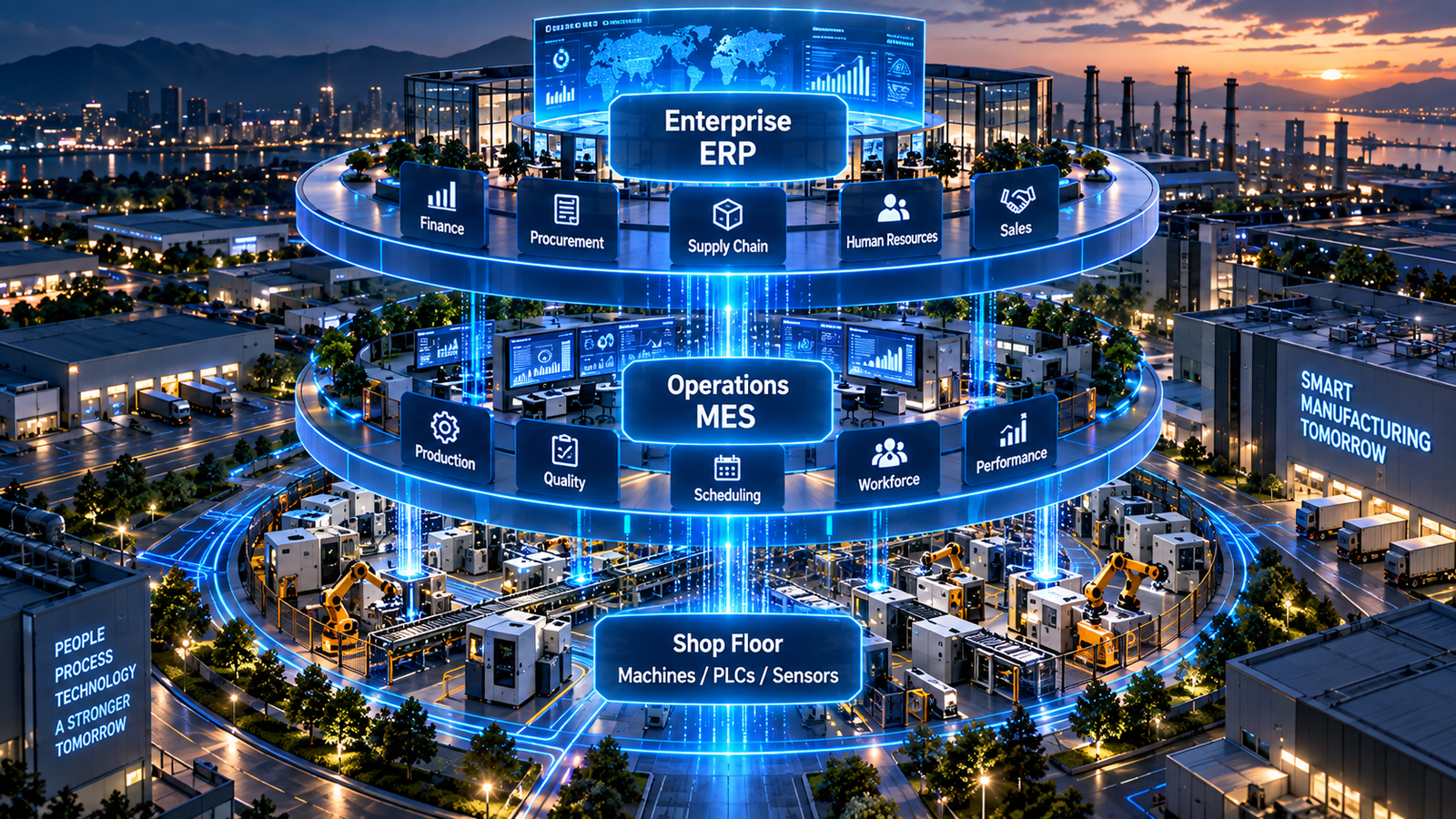
MES vs ERP systems are legitimately old at most manufacturers. Both have a credible modernization business case. And most manufacturers can’t afford to modernise both simultaneously without stretching risk and budget past what the floor can absorb in one go. Picking the wrong one first is a common reason manufacturing modernization programmes lose momentum after the first phase – the modernised system works fine, but it doesn’t relieve the constraint that was actually hurting the business.
Two Different Constraints Wearing the Same Label
ERP modernization relieves planning, financial, and procurement constraints – it’s the system that determines whether the business has accurate visibility into cost, demand, and resource allocation. MES modernization relieves shop-floor execution constraints – it’s the system that determines whether work orders, production tracking, and quality data are accurate and timely on the line itself. A manufacturer whose real pain is planning inaccuracy will get limited relief from an MES upgrade, and a manufacturer whose real pain is shop-floor traceability will get limited relief from an ERP upgrade – yet both projects get pitched, and often funded, as generic “legacy modernization,” obscuring which constraint they actually address.
Side-by-Side Comparison
| Dimension | ERP Modernization | MES Modernization |
|---|---|---|
| What it solves | Planning inaccuracy, financial visibility gaps, procurement inefficiency | Shop-floor execution visibility, work order accuracy, quality traceability |
| Typical timeline | 12 to 24 months, often phased by module | 8 to 16 months, phased by line or plant |
| Physical connection risk | Lower – mostly back-office, financial, and planning data | Higher – directly tied to live production tracking and work orders |
| Best first move when… | Planning, forecasting, or procurement decisions are made on stale or inaccurate data | Production tracking, quality data, or work order accuracy is the acute operational pain |
| Typical investment range | High – often the largest single system in the enterprise stack | Moderate to high, scales with number of lines and plants |
| Dependency | Often has downstream dependents (MES, reporting) relying on its data | Depends on accurate, timely data feeding from SCADA and control layer beneath it |
| Cutover risk profile | Disruption mainly affects planning and back-office functions during transition | Disruption can directly affect live production output during transition |
How the Two Systems Actually Interact
It’s worth being explicit about why ERP and MES modernization aren’t fully independent decisions, even though they’re often budgeted as separate line items. MES depends on ERP for accurate product, routing, and demand data – if the ERP data feeding into MES is unreliable, even a beautifully modernised MES will produce unreliable output, because it’s faithfully executing against bad upstream information. This is a common and frustrating outcome: a manufacturer modernises MES, expects a clean improvement, and instead inherits the same data quality problems in a shinier interface, because the root cause was upstream in ERP all along.
The reverse dependency matters too. A well-scoped MES modernization generates detailed, real-world data about actual production patterns, exceptions, and bottlenecks that can meaningfully improve the accuracy of ERP-level planning and forecasting once it’s fed back upstream – turning what looks like a one-way dependency into a genuine feedback loop, if the architecture is designed to support it.
Decision Criteria
Choose ERP modernization first if your acute pain is in planning, forecasting, procurement, or financial visibility – if your teams are making decisions on data that’s stale, inaccurate, or reconciled manually across systems, no amount of shop-floor system improvement will fix that upstream visibility gap.
Choose MES modernization first if your acute pain is on the floor itself – inaccurate work orders, slow or unreliable quality data, poor production traceability – especially if your ERP data is reasonably trustworthy already and the bottleneck is clearly in how that data translates into floor execution.
Choose both, sequenced, if you’re seeing both symptoms – which describes most manufacturers running systems installed more than a decade apart from each other. Sequencing ERP first is usually lower-risk from a physical-disruption standpoint, but MES-first can be the right call when floor-level pain is acute enough that waiting through a multi-year ERP programme isn’t tenable.
The Business Case for Sequencing Both
Manufacturers who modernise ERP before MES report cleaner MES implementations afterward, because the MES layer inherits more accurate planning and product data from the start rather than having to work around ERP-side data quality issues. Manufacturers who modernise MES first, when floor-level pain is the more urgent constraint, typically see faster visible ROI – production traceability and quality gains show up within months – and can use that momentum and demonstrated value to build the internal case for the larger, longer ERP programme that follows.
A Note on Plant-Level Politics
Beyond the technical dependency question, ERP and MES modernization decisions are frequently entangled in plant-level politics that are worth naming honestly. ERP is typically an IT and finance-owned system, with its modernization business case built and championed by corporate functions. MES is typically plant-operations-owned, with its business case built and championed by people closer to the physical floor. Whichever function has more influence over the current budget cycle often gets its system prioritised first – regardless of which one is actually the more binding constraint on the business. Manufacturers that explicitly name this dynamic and force a constraint-based decision, rather than letting organisational influence decide by default, consistently make better sequencing calls than those where the loudest internal advocate wins by default.
What This Looks Like in a Real Budget Cycle
A manufacturer with a finite modernization budget and both systems genuinely aging often does best allocating a smaller initial tranche to MES – targeting the highest-pain line or plant first – while scoping the larger ERP programme in parallel rather than sequentially. This avoids the common trap of a multi-year ERP programme consuming the entire modernization budget and timeline before the floor sees any visible improvement at all, which is a well-documented way manufacturing modernization initiatives lose internal executive sponsorship partway through.
Why This Decision Gets Harder the Longer It’s Deferred
Deferring the decision by running both systems on minimal, deferred-maintenance budgets – patching the oldest failures without a real modernization plan for either – is the option that consistently performs worst. Deferred ERP problems compound as planning inaccuracy accumulates across more product lines and more complex demand patterns over time. Deferred MES problems compound as quality and traceability gaps make root-cause investigations slower and less reliable with each incident, and as the underlying legacy system becomes progressively harder to find vendor support or skilled maintainers for. Manufacturers that defer both for several years typically face a materially larger, more disruptive modernization programme when they finally commit, because the dependency web has only grown more tangled in the meantime.
A Practical Path
If starting with ERP: scope the MES-facing data interfaces early, even if MES modernization itself is a later phase, so the new ERP doesn’t recreate the same data quality gaps the old one had when handing off to MES.
If starting with MES: audit what ERP data the new MES will depend on, and flag known ERP data quality issues explicitly, so the MES implementation team isn’t surprised mid-project by unreliable upstream data they assumed was clean.
What Doesn’t Change Regardless of Which You Pick First
Two things hold true no matter which system a manufacturer modernises first. First, the dependency between them is real and has to be designed for explicitly – treating either system as a fully standalone project, with no plan for how it hands data to or receives data from the other, is how manufacturers end up re-doing integration work a second time shortly after the first modernization completes. Second, physical-connection risk discipline matters more for MES than for ERP, but it never fully disappears from either – even an ERP cutover, ostensibly back-office, can disrupt production if a plant relies on ERP-driven procurement timing to avoid material shortages on the line. Institutions that internalise both constants tend to plan more realistic timelines and encounter fewer surprise dependencies mid-programme than those still treating each system as an island.
Why SMI TECHSOLUTIONS
SMI TECHSOLUTIONS diagnoses which constraint – planning and financial visibility, or shop-floor execution – is actually binding your business before recommending where to start, and we scope the interdependencies between ERP and MES explicitly rather than treating either as a standalone project. Our manufacturing modernization engagements are built around your production calendar and physical risk tolerance, not a generic IT rollout timeline.
Related Reading
- Legacy System Modernization for Manufacturers: The Enterprise Leader’s Complete Guide
- Why Manufacturing ERP and MES Modernization Projects Fail on the Shop Floor
Related Services
- Legacy Modernization
- Manufacturing
- Digital Transformation
- Data Modernisation
- Data Migration
- Bespoke Development
Not sure whether ERP or MES should come first? Talk to our team.