




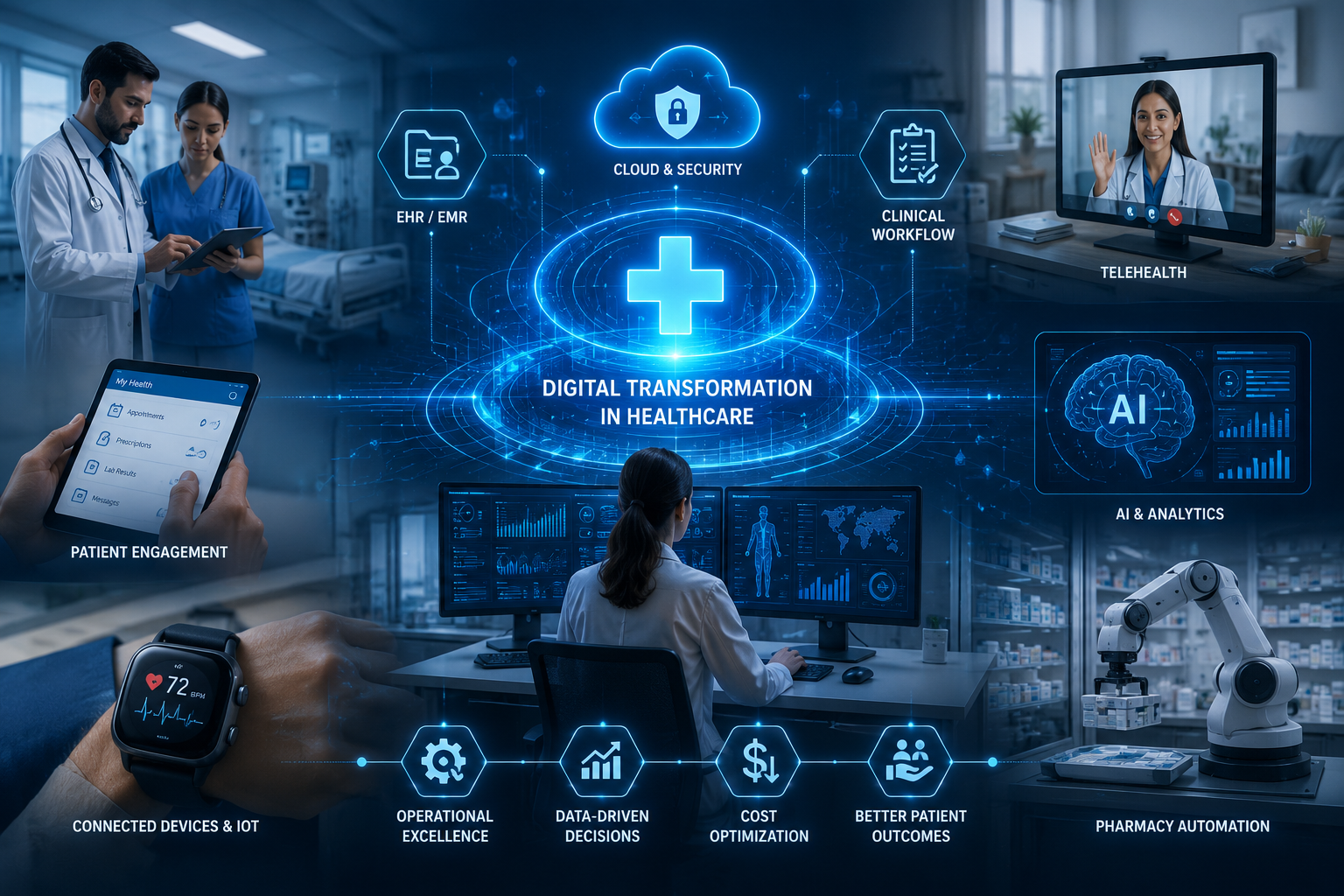
Few sectors carry the weight that healthcare does when technology falls short. A delayed lab result, a clinician re-entering the same patient history into a third disconnected system, a discharge summary that never reaches the primary care physician – these are not abstract inefficiencies, they are the daily texture of a healthcare system whose technology hasn’t kept pace with the complexity of the care it delivers. Digital transformation in healthcare means closing that gap, without ever losing sight of patient safety and regulatory obligation along the way.
This guide sets out what digital transformation means specifically for healthcare organisations, the core pillars that make up a genuinely modern clinical and administrative technology capability, how to prioritise investment, and how to build a business case that connects technology to outcomes clinical and financial leadership already track.
What Does Digital Transformation Mean for Healthcare?
For healthcare organisations, digital transformation means connecting clinical systems, administrative processes, and patient-facing services into a coherent capability that supports faster, safer clinical decisions and a genuinely better patient experience – using modernised EHR platforms, interoperable data exchange, clinical analytics, and increasingly AI-driven clinical support, all governed by the compliance and safety standards healthcare uniquely requires.
This is distinct from simply upgrading an EHR platform. A newer EHR, on its own, does not constitute transformation unless it resolves the interoperability gaps, clinical workflow friction, and data fragmentation that most healthcare organisations actually experience day to day.
Signs Your Healthcare Organisation Needs Digital Transformation
Before committing to a transformation programme, healthcare leaders need clarity on whether the challenge is a point tooling gap or a genuine structural constraint. These signals point to the latter:
- Clinicians re-enter the same information across disconnected systems – EHR, lab, pharmacy, and imaging systems don’t share data reliably, forcing manual re-entry and increasing both clinician burden and error risk.
- Care transitions lose critical information – discharge summaries, referrals, and care plans don’t reliably reach the next provider in the patient’s care journey.
- Population health insight is delayed or absent – the organisation cannot reliably identify at-risk patient cohorts or track outcomes across the population it serves.
- Documentation burden is driving clinician burnout – clinical staff spend a disproportionate share of patient-facing time on manual documentation rather than direct care.
- Patients lack digital access to their own care – scheduling, results, and communication with care teams still depend heavily on phone calls and paper processes patients increasingly expect to be digital.
If three or more of these apply, the constraint spans clinical systems, interoperability, and patient experience together – not something a single point solution will resolve.
The Five Pillars of Healthcare Digital Transformation
Healthcare transformation programmes are built from five interconnected capabilities, each carrying its own regulatory and clinical safety considerations.
1. Legacy EHR and EMR Modernization
Modernise the core electronic health record platform where scalability, integration, or vendor support constraints are limiting clinical and administrative capability – while preserving the clinical logic and workflows that remain valid.
Best for: organisations running EHR platforms that cannot integrate with modern interoperability standards, analytics tooling, or AI-driven clinical support.
2. Interoperability and Data Integration
Build standards-based data exchange – using HL7 and FHIR – across EHR, lab, pharmacy, imaging, and external provider systems, closing the gaps that currently force manual re-entry and cause information loss at care transitions.
Best for: organisations where clinical information is fragmented across systems that don’t reliably share data with each other or with external care partners.
3. Clinical Data Analytics and Population Health
Apply analytics to clinical and operational data to identify at-risk patient cohorts, track outcomes, and support value-based care and population health management requirements.
Best for: organisations with population health or value-based care obligations who currently lack the analytics capability to identify and manage risk at a population level.
4. AI-Driven Clinical Decision Support and Documentation
Deploy Gen AI capability for ambient clinical documentation, diagnostic decision support, and administrative automation – always with defined human-in-the-loop review appropriate to clinical risk and regulatory requirement.
Best for: organisations facing significant clinician documentation burden and burnout, where AI-assisted documentation can measurably reduce non-clinical workload.
5. Patient Experience and Digital Front Door
Build patient-facing digital capability – scheduling, results access, secure messaging, telehealth – that meets patient expectations for digital access to their own care, reducing dependence on phone-based coordination.
Best for: organisations where patient satisfaction and access metrics are constrained by predominantly manual, phone-based patient interaction.
How to Prioritise: Choosing Where to Start
The decision comes down to four questions:
- Where is clinical risk or clinician burden most acute today? Documentation burden, interoperability gaps, and care transition failures each point to a different starting pillar.
- How constrained is your current EHR platform? If the core EHR cannot support modern interoperability standards at all, that needs addressing before broader integration or AI capability can be built reliably on top.
- What regulatory or value-based care obligations are driving the timeline? Population health and interoperability mandates often set an external deadline that should influence sequencing.
- What is the realistic change capacity of clinical staff? Clinical teams already under significant workload pressure need change introduced carefully, with genuine workflow benefit, not additional administrative burden.
Most healthcare organisations that succeed sequence interoperability and EHR modernisation first, since analytics, AI-driven clinical support, and patient experience capability all depend on the data foundation those pillars establish.
Building a Business Case for Healthcare Digital Transformation
Healthcare business cases land most effectively when connected to metrics clinical and financial leadership already track. An effective business case addresses:
- Clinician time and burnout reduction – the quantified value of reduced documentation burden and administrative overhead on clinical staff retention and satisfaction.
- Care quality and safety improvement – reduced information loss at care transitions and improved population health management, tied to specific quality metrics the organisation tracks.
- Revenue cycle and operational efficiency – the administrative cost of manual processes that interoperability and automation would reduce.
- Patient satisfaction and access – the value of improved patient-facing digital access on satisfaction scores and care access metrics.
Anchor the business case to specific, named clinical and administrative metrics the organisation already reports – this is a far stronger argument to clinical and executive leadership than a general appeal to “modernising healthcare technology.”
Healthcare Digital Transformation Readiness Checklist
Before initiating a healthcare transformation programme, confirm these foundations are in place:
- Clinical leadership engaged as genuine co-owners, not just IT stakeholders
- Current EHR and interoperability constraints mapped against HL7/FHIR standards
- Regulatory and compliance requirements – including data privacy and security – defined before architecture decisions are finalised
- AI governance framework drafted for any clinical decision support or documentation use case
- Change management resourced specifically for clinical staff, accounting for existing workload pressure
- Success metrics agreed in writing, tied to clinical, operational, or patient experience outcomes the organisation already tracks
Why Healthcare Organisations Choose SMI for Digital Transformation
SMI TECHSOLUTIONS delivers healthcare digital transformation programmes under outcome-driven engagement models, coordinating EHR modernisation, interoperability, clinical analytics, and AI-driven clinical support into a single coherent programme – with the compliance and clinical safety rigor healthcare uniquely requires built in from the start.
Our AI-native engineering approach accelerates the data integration and interoperability work that most healthcare transformation programmes depend on, while our embedded delivery teams carry accountability for the clinical and operational outcomes the programme is built to achieve.
Whether you are modernising a core EHR platform, building standards-based interoperability, or ready to deploy AI-driven clinical support, our healthcare specialists are available to discuss your situation with no commitment required.
Related Services
- Healthcare Solutions
- Digital Transformation
- Legacy Modernization
- Data Engineering & BI Services
- Data Analytics
- Generative AI Services
Ready to modernise your healthcare technology environment? Contact SMI TechSolutions to discuss your healthcare digital transformation requirements.