




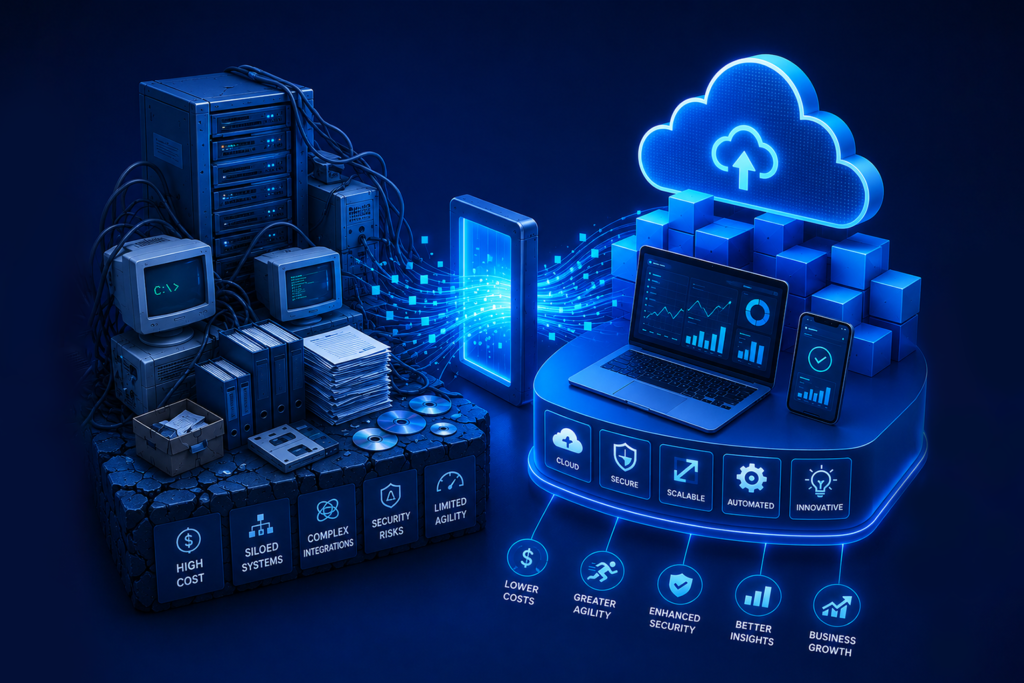
Legacy systems don’t fail overnight. They accumulate – layer by layer, workaround by workaround – until the cost of doing nothing outweighs the complexity of change. At that point, most enterprises face the same question: how do you modernise a system the business depends on daily, without disrupting the operations it supports?
This guide answers that question directly. It covers what legacy modernisation actually means, the five strategies available to IT leaders, how to choose the right one, and how to build a business case that secures board-level buy-in.
Whether you are dealing with a 20-year-old ERP, a monolithic banking platform, or a patchwork of on-premise applications – the principles here apply.
What Is Legacy System Modernization?
Legacy modernisation is the process of updating, replacing, or restructuring outdated software systems to meet current technical and business requirements. It spans everything from minor cloud hosting changes to complete re-architecture from monolith to microservices.
The term ‘legacy’ doesn’t always mean old – it means constrained. A system built five years ago can be legacy if it can’t integrate with modern APIs, scale on-demand, support AI workloads, or be maintained without specialist knowledge of an obsolete stack.
Modernisation is not a single project. It is a strategic programme with clear phases, measurable milestones, and defined business outcomes – executed alongside live operations.
Signs Your Legacy System Is Holding the Business Back
Before committing to modernisation, IT leaders need clarity on whether pain points are symptoms of poor configuration or structural system limitations. These signals indicate the latter:
- Integration failures – the core system cannot connect to modern SaaS platforms, APIs, or cloud services without expensive custom middleware.
- Talent scarcity – the system runs on a stack that fewer engineers know. COBOL, Delphi, and legacy RDBMS expertise is shrinking, making maintenance expensive and risky.
- Scaling constraints – performance degrades under increased load and cannot be horizontally scaled without significant infrastructure investment.
- AI readiness gaps – real-time data cannot be fed into machine learning pipelines or AI models deployed alongside the system because the architecture does not support it.
- Audit and compliance friction – generating regulatory reports requires manual extraction and transformation, introducing error risk and consuming analyst time.
- Escalating maintenance cost – the system consumes a disproportionate share of your IT budget just to stay operational, with no capacity for feature development.
If three or more of these apply, modernisation is not a question of whether – it is a question of which strategy and when.
The 5 Modernization Strategies – Explained
Legacy modernisation is not one-size-fits-all. The right approach depends on system complexity, business criticality, budget, and target architecture. The five strategies – commonly known as the 5 Rs – provide a practical decision framework.
1. Rehost (Lift-and-Shift)
Move the application to a new infrastructure environment – typically from on-premise servers to cloud – without changing its code or architecture. This is the fastest and lowest-risk strategy, but it delivers limited functional improvement. The system runs on the same code; it just runs elsewhere.
Best for: systems that are functionally adequate but need immediate infrastructure cost reduction or data centre consolidation.
2. Refactor (Code Optimisation)
Restructure and improve the existing codebase – cleaning up technical debt, improving modularity, and updating to current coding standards – without changing the underlying architecture. The application does what it always did, but the code is cleaner, more maintainable, and more performant.
Best for: systems with sound architecture but accumulated technical debt that is slowing development velocity.
3. Re-platform (Lift-Tinker-and-Shift)
Move to a new environment while making targeted optimisations – typically replacing specific components such as the database or middleware layer to take advantage of cloud-native services. The core application logic remains largely unchanged.
Best for: systems that need cloud-native benefits – managed scaling, serverless components, cloud databases – without a full rebuild.
4. Rebuild (Re-engineer)
Re-design and rebuild the application from scratch using modern architecture principles – microservices, event-driven design, API-first – while retaining the same business logic. The most resource-intensive strategy, but it delivers the highest long-term value.
Best for: mission-critical systems where the existing architecture is structurally incompatible with future requirements – AI integration, real-time processing, cloud-native scalability.
5. Retire
Decommission the system entirely. The right call when the system is no longer serving a relevant business function, its users have migrated elsewhere, or its functionality can be absorbed into a larger platform.
Best for: systems that have become redundant and whose maintenance cost exceeds their business value.
How to Choose the Right Strategy for Your System
The decision comes down to four variables:
- Business criticality: how dependent is the organisation on this system’s uptime and performance?
- Architecture fitness: can the current architecture support future requirements, or is it structurally incompatible?
- Technical debt level: how much accumulated complexity exists in the codebase?
- Timeline and budget: what is the acceptable risk-to-speed ratio for the business?
A rehost makes sense as an immediate tactical move for systems needing infrastructure modernisation quickly. A rebuild is the right call for systems that need to support Gen AI, real-time data pipelines, and modern API ecosystems over a 3–5 year horizon.
Many large enterprise programmes run multiple strategies in parallel – rehosting lower-priority systems immediately while rebuilding mission-critical applications over a longer programme.
Building a Business Case Your CFO Will Approve
The most common reason modernisation programmes stall is not technical complexity – it is the inability to quantify business value in financial terms. An effective business case addresses four categories:
- Cost reduction – maintenance savings, infrastructure consolidation, reduced licencing fees, and talent cost reduction by replacing specialist knowledge with standard skills.
- Revenue enablement – new product capabilities, faster time-to-market for features, and customer experience improvements enabled by the modernised system.
- Risk reduction – security vulnerability mitigation, compliance improvement, and business continuity improvement through modern disaster recovery architecture.
- Operational efficiency – faster deployment cycles, reduced integration overhead, and improved developer productivity.
Quantify each category with conservative estimates, time-bound assumptions, and sensitivity analysis. A modernisation programme with a clear 3-year ROI, phased delivery milestones, and defined risk mitigation is a fundable investment – not a discretionary cost.
Legacy Modernization Readiness Checklist
Before initiating a modernisation programme, confirm these foundations are in place:
- Clear executive sponsor with budget authority and business accountability
- Application dependency mapping completed – you know what integrates with what
- Business continuity requirements defined – what downtime (if any) is acceptable
- Target architecture agreed – you know where the system needs to end up
- Vendor and partner selection criteria defined – not evaluating on cost alone
- Success metrics agreed in writing – you have defined what ‘done’ looks like before you start
- Change management plan in place – user adoption is as important as technical delivery
Why Enterprises Choose SMI for Legacy Modernization
SMI TECHSOLUTIONS delivers legacy modernisation programmes under outcome-driven engagement models – which means we carry execution risk alongside you. Our AI-native engineering approach, powered by Claude, Copilot, and Cursor-led development, accelerates migration timelines by up to 50% compared to traditional delivery.
We don’t hand you a plan and leave you to execute. Our embedded teams work inside your development cycle – with full accountability to the milestones that matter to your business. From the initial assessment through to production deployment, we are with you at every stage.
Whether you are at the assessment stage or ready to begin, our transformation specialists are available to discuss your specific situation with no commitment required.