




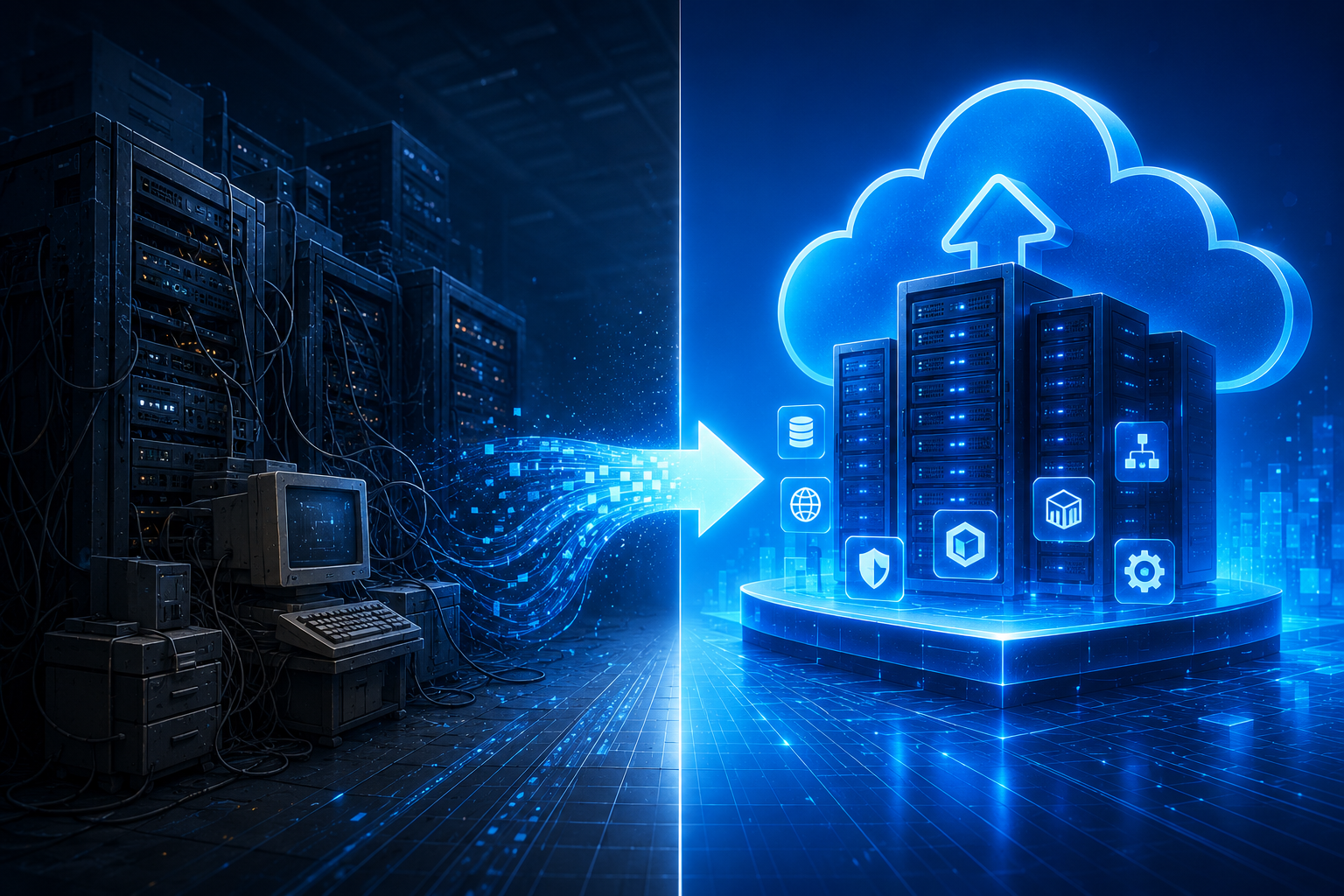
When a business case for cloud migration reaches the IT leadership team, it is often positioned as a legacy modernization initiative. Likewise, discussions around digital transformation frequently present cloud migration as the primary outcome of modernization.
Although these terms are often used interchangeably, they represent two distinct strategies. Confusing them can lead to programmes that achieve the wrong outcome-applications are successfully moved to the cloud but remain difficult to maintain, integrate, or scale. In other cases, organizations attempt to modernize and migrate simultaneously without a clear roadmap, significantly extending project timelines.
This guide explains the differences between Legacy Modernization and cloud migration, outlines when each approach is appropriate, and provides a phased roadmap for enterprises planning both initiatives.
Defining the Terms
What Is Cloud Migration?
Cloud migration is the process of moving applications, data, workloads, or infrastructure from on-premise environments or co-located data centres to a cloud platform. It is primarily an infrastructure initiative.
The most common migration strategy is lift-and-shift, where applications are moved with little or no modification to their existing code or architecture. The application continues to function exactly as before-it simply operates on cloud infrastructure instead of physical servers.
Cloud migration provides several infrastructure benefits, including:
- Reduced data centre operating costs
- Improved disaster recovery capabilities
- Access to managed cloud services
- Better scalability and geographic redundancy
However, cloud migration alone does not modernize an application or improve its underlying architecture.
What Is Legacy Modernization?
Legacy Modernization focuses on updating or replacing the application itself-its codebase, architecture, integrations, or technology stack. It is fundamentally an application engineering exercise rather than an infrastructure project.
Modernization may include migrating an application to the cloud, but cloud infrastructure is simply the destination-not the defining outcome. A modernized application can continue running on-premise, while a legacy application moved unchanged to the cloud remains a legacy application.
The distinction is important because the objectives, project timelines, investment levels, required skills, and implementation risks differ significantly between cloud migration and modernization initiatives.
Why Enterprises Confuse Cloud Migration and Legacy Modernization
The confusion is understandable. Cloud providers frequently position cloud adoption as modernization, while technology partners often bundle cloud migration and modernization into a single engagement. Under pressure to demonstrate measurable progress in Digital Transformation, organizations may also treat infrastructure improvements as application modernization.
The result is a programme that successfully migrates applications to the cloud but leaves the business with systems that still struggle to support modern APIs, AI integration, real-time data processing, or scalable digital services.
Cloud infrastructure is an important foundation for modernization, but infrastructure alone does not create a modern application landscape.
Lift-and-Shift vs True Modernization
| Dimension | Cloud Migration (Lift-and-Shift) | Legacy Modernization |
|---|---|---|
| Primary Objective | Infrastructure cost reduction | Application capability improvement |
| Code Changes | Minimal or none | Significant refactoring or rebuilding |
| Typical Timeline | 3–6 months | 6–24 months |
| Risk Profile | Lower | Higher due to application re-engineering |
| Business Disruption | Minimal | Moderate to significant |
| AI & API Readiness | No significant improvement | High readiness for modern integrations |
| Maintenance Costs | Modest reduction | Substantial long-term reduction |
| Required Skills | Infrastructure & DevOps | Software Engineering & Solution Architecture |
| Outcome | Lower infrastructure costs | Modern, scalable, AI-ready applications |
This comparison highlights a critical distinction. Cloud migration changes where an application runs, while Legacy Modernization changes what the application is capable of achieving.
Most enterprise environments require both approaches, but they should be planned with different objectives and executed using the right sequence.
When to Migrate, When to Modernize, and When to Do Both
Choose Cloud Migration When:
- Your primary objective is reducing infrastructure and data centre costs.
- The application already meets business requirements but operates on expensive on-premise infrastructure.
- You need quick wins to demonstrate cloud ROI.
- The application is expected to be retired within the next two to three years.
Choose Legacy Modernization When:
- The application cannot support APIs, AI capabilities, or real-time integrations.
- Maintenance consumes a significant portion of the IT budget.
- Legacy architecture limits digital transformation initiatives.
- Finding skilled resources for the existing technology stack is becoming increasingly difficult.
Organizations planning enterprise AI initiatives often modernize applications first to prepare them for Generative AI, intelligent automation, and API-driven business processes.
Choose Both-But in Sequence-When:
- Infrastructure requires immediate modernization while applications also need long-term re-engineering.
- The modernization programme will extend beyond 18 months.
- The business needs early cloud benefits while application modernization progresses in parallel.
The Phased Roadmap: Running Both Without Disruption
Phase 1: Assessment and Architecture Decision (4–6 Weeks)
Before beginning migration or modernization, perform a structured assessment of every application.
Classify systems based on whether they should be:
- Rehost
- Re-platform
- Refactor
- Rebuild
- Retire
Identify interdependencies, evaluate business continuity requirements, and define a phased implementation roadmap.
This assessment creates a clear programme with realistic milestones and reduces implementation risk.
Phase 2: Cloud Migration – Infrastructure Foundation (3–6 Months)
Applications suitable for rehosting should be migrated using structured implementation sprints.
The objective during this phase is infrastructure stabilization-not application redesign.
Moving workloads to cloud infrastructure establishes a stable platform for future modernization while reducing operational costs.
Phase 3: Modernization Waves (6–18 Months)
Once infrastructure is stable, application modernization should be delivered in business-focused waves.
Each modernization wave typically includes:
- Assessment
- Solution Design
- Application Refactoring
- Testing
- Deployment
- Performance Validation
Organizations frequently combine Bespoke Development with modernization programmes to build scalable applications that support AI integration, APIs, and cloud-native architectures.
Phase 4: Continuous Optimization
Cloud-native applications require continuous optimization, including cost monitoring, security improvements, performance tuning, and feature enhancements.
Modernization should therefore be viewed as an ongoing capability rather than a one-time project.
Common Pitfalls When Running Cloud Migration and Legacy Modernization Together
Running cloud migration and Legacy Modernization simultaneously-rather than as sequenced initiatives-is one of the most common mistakes enterprises make. Although both programmes are closely related, attempting to execute them together often increases complexity, stretches delivery timelines, and introduces unnecessary risk.
1. Scope Entanglement
A cloud migration project may initially appear straightforward until teams discover that the application requires significant architectural changes to function efficiently in the cloud. What begins as a six-week lift-and-shift initiative can quickly evolve into a year-long modernization programme.
Separating infrastructure migration from application modernization helps maintain clear objectives, reduces delivery risk, and keeps projects on schedule.
2. Resource Contention
Cloud migration and modernization frequently depend on the same technical specialists, including cloud engineers, solution architects, DevOps professionals, and software developers. Running both programmes simultaneously creates resource bottlenecks that delay progress across both initiatives.
Planning phased delivery allows teams to focus on one objective at a time while making better use of available expertise.
3. Increased Delivery Risk
Every enterprise transformation programme carries implementation risk. Running two complex initiatives simultaneously significantly increases the likelihood of delays, dependency conflicts, testing challenges, and business disruption.
If both programmes encounter critical issues at the same time, the operational impact on the business can be substantial.
4. Missing AI and Digital Transformation Goals
Many organisations move applications to the cloud expecting immediate support for AI, APIs, automation, and real-time analytics. However, if the underlying application architecture remains unchanged, those capabilities remain difficult-or impossible-to implement.
To fully support AI-driven digitalisation, applications often require architectural modernization in addition to cloud infrastructure.
The most effective strategy is disciplined sequencing: stabilize infrastructure first, then modernize applications in structured delivery waves. Although this approach may add several weeks to the overall programme, it typically reduces rework, improves governance, and delivers better long-term business outcomes.
The Bottom Line
Cloud migration and Legacy Modernization are complementary initiatives, but they are not the same programme.
Cloud migration focuses on where applications run by moving infrastructure to the cloud, improving scalability, resilience, and infrastructure efficiency. Legacy modernization focuses on what applications can do by improving architecture, maintainability, integration capabilities, and long-term business value.
For most enterprises, the recommended approach is a phased strategy:
- Assess the current application landscape.
- Classify applications based on migration and modernization requirements.
- Migrate suitable workloads to establish a stable cloud foundation.
- Modernize business-critical applications through structured implementation waves.
- Continuously optimize cloud-native applications for performance, security, and cost efficiency.
This phased approach reduces implementation risk, delivers early infrastructure benefits, and creates a modern, scalable, and AI-ready application landscape capable of supporting future innovation.
Organizations pursuing broader Digital Transformation initiatives should view cloud migration as the foundation and modernization as the long-term strategic investment that unlocks APIs, intelligent automation, analytics, and enterprise AI capabilities.
Why Choose SMI TECHSOLUTIONS?
SMI TECHSOLUTIONS helps enterprises modernize legacy systems through a structured combination of Legacy Modernization, Bespoke Application Development, Data Modernisation, cloud adoption, and AI-driven Digitalisation.
Our consultants assess your existing technology landscape, identify the most suitable modernization strategy, and create phased implementation roadmaps that minimize business disruption while accelerating innovation.
Whether your objective is reducing infrastructure costs, modernizing mission-critical applications, enabling AI adoption, or supporting enterprise-scale digital transformation, our experts help you build a secure, scalable, and future-ready technology ecosystem.
Next Step
If you’re evaluating whether to begin with cloud migration or legacy modernization, the best place to start is with a structured assessment of your existing application portfolio.
For a deeper understanding of modernization strategies, implementation approaches, and best practices, explore our comprehensive guide on Legacy Modernization and discover how SMI TECHSOLUTIONS can help accelerate your modernization journey.