




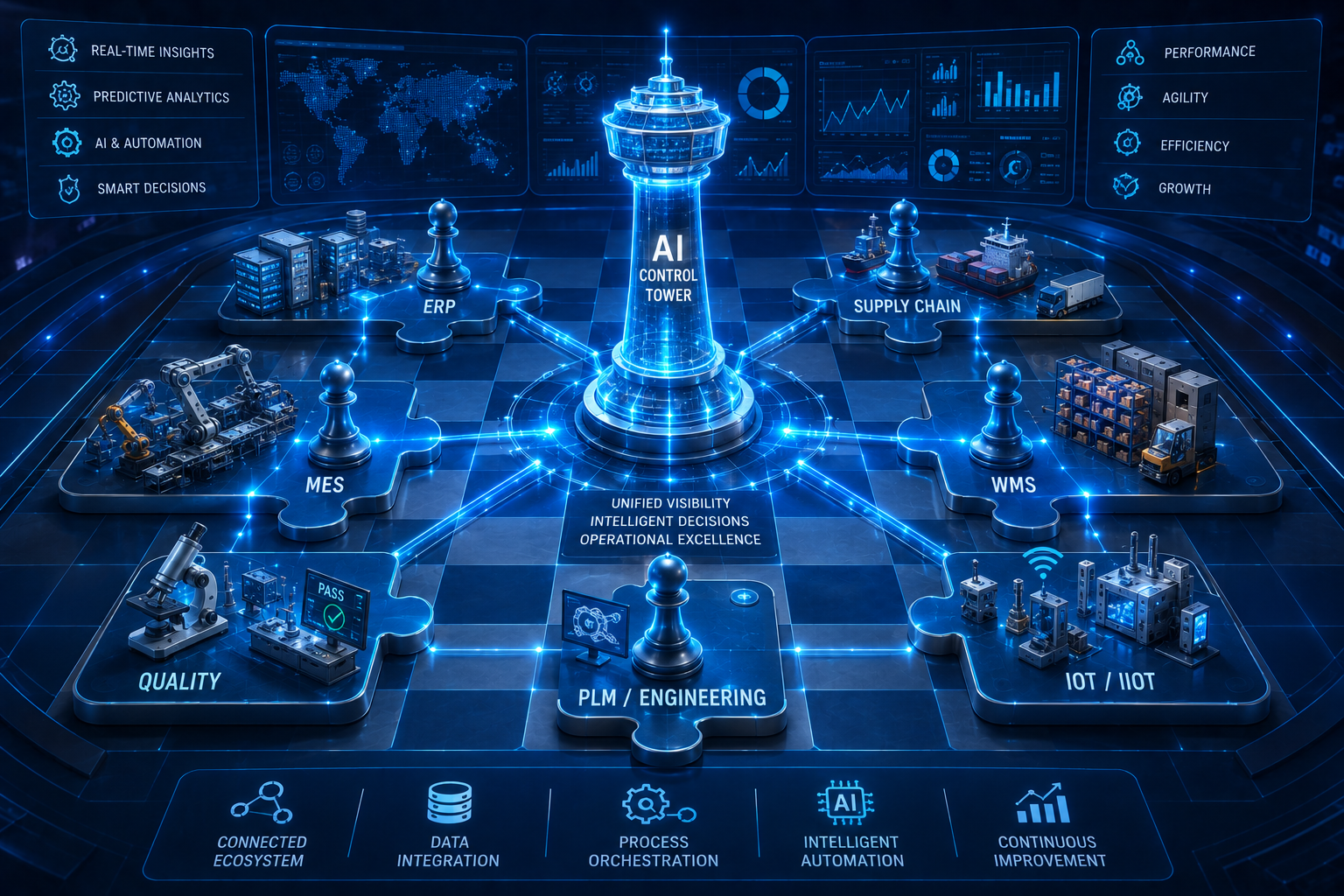
Manufacturing leaders facing a transformation decision routinely hit the same fork: modernise the ageing MES and ERP systems that run production, or build a real-time data control tower that gives visibility across what already exists. Both are legitimate, high-value investments – and choosing the wrong one first is one of the most common causes of manufacturing transformation programmes stalling or underdelivering.
This post draws a precise line between the two, explains when each should come first, and sets out a phased roadmap for manufacturers that need both.
Defining the Terms
What Is MES Modernization?
MES (Manufacturing Execution System) modernisation is the process of updating, replacing, or re-architecting the core system that manages and tracks production execution – work orders, machine scheduling, quality tracking, and production reporting. It addresses the system of record for how production actually runs.
For manufacturers evaluating broader legacy modernisation, MES modernisation can be an important component when ageing production systems are limiting integration, scalability, or operational capability.
What Is a Manufacturing Data Control Tower?
A manufacturing data control tower is a real-time integration and visibility layer that draws data from the MES, ERP, SCADA systems, and supply chain sources into a unified operational view, with exception alerting designed to catch disruption before it compounds. It does not replace the MES – it sits alongside and across existing systems, making their data visible in ways those systems don’t natively support.
Manufacturers can use a Data Control Tower / Digital Cockpit approach to bring operational data together and improve real-time visibility across production and supply chain activities.
Why Manufacturers Confuse the Two
The confusion arises because both initiatives are frequently pitched under the same “digital transformation” or “Industry 4.0” banner, and both ultimately aim to improve production visibility and decision-making. But they operate at different layers: MES modernisation changes the system that runs production; a control tower changes what you can see across systems, without necessarily changing any of them.
The practical risk is manufacturers commissioning a control tower on top of an MES so constrained that it cannot provide the real-time data the control tower needs – or modernising the MES without addressing the cross-system visibility gap that was the original source of frustration.
Side-by-Side Comparison
| Dimension | MES Modernization | Manufacturing Data Control Tower |
|---|---|---|
| Primary objective | Modernise the system running production | Unify real-time visibility across existing systems |
| Starting point | Existing MES platform and its constraints | Data already present across multiple systems |
| Typical timeline | 6-18 months depending on scope | 2-5 months for an initial priority domain |
| Risk profile | Higher – core production system changes | Lower – visibility layer, systems unchanged |
| Production disruption | Moderate to significant (managed via phasing) | Minimal |
| Dependency | Can be built independently | Depends on source system data quality and refresh capability |
| Typical outcome | Modern, scalable, integration-ready MES | Real-time cross-system visibility and faster response |
The table illustrates the core tradeoff: MES modernisation is the higher-risk, higher-reward investment that changes the production system itself, while a control tower is a faster, lower-disruption investment that depends on the data quality of whatever systems – modern or legacy – are already in place.
When to Modernize MES First, When to Build a Control Tower First, and When to Do Both
Modernize the MES first when:
- The current MES cannot provide real-time or even reliably accurate data to any downstream visibility layer.
- Production planning and execution are themselves constrained by the MES, not just invisible to leadership.
- The MES is approaching end-of-life support or carries significant technical risk on its own.
Build a control tower first when:
- Existing systems – MES, ERP, SCADA – can provide adequate data, but no unified view currently exists across them.
- The immediate priority is faster detection of and response to production or supply chain disruption.
- A full MES modernisation is a longer-term initiative and the organisation needs earlier value from improved visibility.
Do both – in sequence – when:
- The current MES has both production execution constraints and data quality issues limiting visibility.
- A control tower is needed for near-term value while a longer MES modernisation programme is planned and resourced.
The Phased Roadmap: Sequencing Both
Phase 1: Assessment (3-5 weeks)
Assess the current MES’s genuine data quality and real-time capability, and classify whether visibility gaps stem from the MES itself or simply from the absence of cross-system integration.
Phase 2: Control Tower for Immediate Visibility (2-5 months)
Where existing systems can provide adequate data, build the control tower first to deliver near-term visibility value while a longer MES modernisation is scoped and resourced.
Phase 3: MES Modernization (6-18 months)
Modernise the MES on a timeline that reflects its genuine complexity, using the control tower’s operational insight to inform which production execution capabilities matter most in the new system.
Phase 4: Integration and Continuous Optimisation (ongoing)
Once the modernised MES is live, extend the control tower to draw on its improved data quality and real-time capability, and continue refining both as production priorities evolve.
Common Pitfalls
- Building a control tower on an MES that can’t supply real-time data – investing in a visibility layer that inherits the same staleness and inaccuracy as the system underneath it.
- Modernising the MES without addressing cross-system visibility – delivering a modern production system that still leaves leadership without the unified view they originally needed.
- Treating both as the same investment with the same risk profile – underestimating the production disruption risk of MES modernisation relative to the comparatively low-risk control tower build.
The Bottom Line
MES modernisation and a manufacturing data control tower solve different problems – one changes the system that runs production, the other changes what you can see across the systems already in place. The right starting point depends on whether your current constraint is the production system itself or the absence of unified visibility across it.
For most manufacturers facing both challenges, sequencing a control tower first – to deliver near-term visibility value – while planning a longer MES modernisation programme in parallel, delivers the best balance of speed and long-term capability.
Related Services
- Manufacturing Solutions
- Legacy Modernization
- Power BI / Data Control Tower / Digital Cockpit
- Data Engineering & BI Services
- Digital Transformation
Evaluating MES modernisation and real-time manufacturing visibility? Contact SMI TechSolutions to discuss the right sequence for your manufacturing transformation programme.