




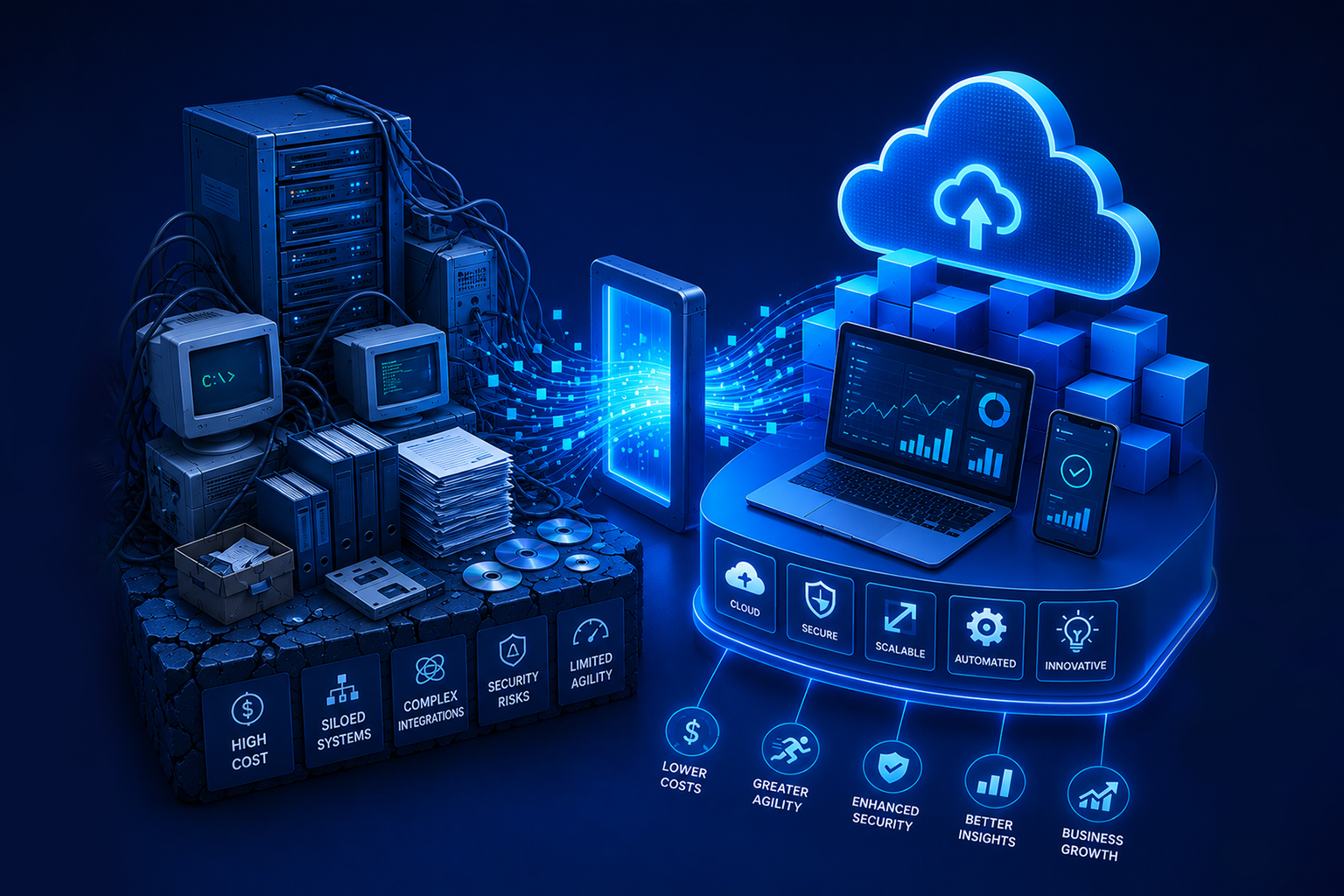
Legacy systems rarely fail overnight. Instead, they become increasingly difficult to maintain as years of enhancements, customisations, and workarounds accumulate. Eventually, organizations reach a point where the cost of maintaining the existing system exceeds the investment required to modernize it.
At that stage, enterprise leaders face a familiar challenge: how do you modernize a mission-critical application without disrupting the business processes that depend on it every day?
This guide explains what Legacy Modernization really means, explores the five modernization strategies available to enterprise IT leaders, explains how to choose the right approach, and outlines how to build a compelling business case that secures executive approval.
Whether you’re managing a decades-old ERP platform, a monolithic banking application, or a collection of on-premise enterprise systems, these principles provide a practical roadmap for successful modernization.
What Is Legacy System Modernization?
Legacy modernization is the process of updating, replacing, or restructuring outdated software systems so they can meet current business and technology requirements. Modernization ranges from simple infrastructure upgrades to complete application re-engineering using modern architectures.
The term legacy does not necessarily mean old. A system can be only a few years old and still be considered legacy if it cannot integrate with modern APIs, support cloud-native deployments, scale efficiently, or enable AI-driven business processes.
Successful Legacy Modernization is not a single implementation project. It is a strategic transformation programme delivered through clearly defined phases, measurable milestones, and business-focused outcomes while maintaining day-to-day operations.
Signs Your Legacy System Is Holding the Business Back
Before investing in modernization, organizations should determine whether current challenges are caused by configuration issues or structural limitations within the application itself.
The following indicators suggest that modernization should become a strategic priority.
Integration Challenges
The application struggles to integrate with cloud platforms, SaaS applications, APIs, or modern enterprise services without expensive custom middleware.
Limited Talent Availability
The system relies on outdated programming languages or platforms such as COBOL, Delphi, or legacy database technologies, making experienced developers increasingly difficult and expensive to hire.
Scalability Limitations
Application performance degrades as workloads increase, and scaling requires significant infrastructure investment rather than flexible cloud-native resources.
AI Readiness Gaps
Modern AI initiatives require accessible, real-time data and API-enabled architectures. Legacy applications often lack the capabilities needed to support AI-driven digitalisation, machine learning, and intelligent automation.
Compliance and Reporting Challenges
Generating regulatory reports depends on manual data extraction and spreadsheet manipulation, increasing operational effort and compliance risk.
Rising Maintenance Costs
The application consumes a disproportionate percentage of the IT budget simply to remain operational, leaving little room for innovation or feature development.
If three or more of these indicators apply to your environment, modernization is no longer a question of if, but when and which modernization strategy best fits your business objectives.
The Five Legacy Modernization Strategies
There is no universal modernization approach. The appropriate strategy depends on application complexity, business criticality, technical debt, available budget, and long-term technology goals.
1. Rehost (Lift-and-Shift)
Rehosting moves an application from on-premise infrastructure to a cloud environment without modifying its code or architecture.
This is typically the fastest and lowest-risk modernization option because the application continues operating exactly as before—it simply runs on different infrastructure.
Best suited for: Applications that remain functionally effective but require infrastructure consolidation or lower operating costs.
2. Refactor (Code Optimization)
Refactoring improves the application’s existing codebase by reducing technical debt, improving maintainability, and aligning with modern development standards while preserving the overall architecture.
The application’s functionality remains unchanged, but developers benefit from cleaner, more maintainable code.
Best suited for: Applications with solid architecture but declining development productivity due to accumulated technical debt.
3. Re-platform (Lift, Tinker, and Shift)
Re-platforming combines cloud migration with targeted improvements, such as replacing legacy databases, middleware, or infrastructure components while preserving the application’s core business logic.
This approach allows organizations to leverage cloud-native capabilities without undertaking a complete rebuild.
Best suited for: Organizations seeking managed cloud services, improved scalability, and modern infrastructure while minimizing application changes.
Many enterprises combine re-platforming with Data Modernisation initiatives to improve data accessibility and analytics capabilities.
4. Rebuild (Re-engineering)
Rebuilding involves designing and developing the application from the ground up using modern software architecture principles such as microservices, API-first development, and event-driven architecture.
Although this strategy requires the greatest investment, it provides the highest long-term business value by creating scalable, maintainable, and future-ready enterprise applications.
Best suited for: Mission-critical systems that must support cloud-native architectures, AI integration, real-time analytics, and enterprise scalability.
Organizations often combine rebuilding with Bespoke Development to create applications tailored to their business processes.
5. Retire
Not every application requires modernization.
Some legacy systems no longer provide meaningful business value, have already been replaced, or perform functions that can be consolidated into other enterprise platforms.
In these situations, retiring the application is often the most cost-effective strategy.
Choosing the Right Modernization Strategy
Selecting the appropriate modernization path depends on four key considerations:
- Business criticality of the application
- Current architectural fitness
- Technical debt and maintenance complexity
- Available budget, timeline, and acceptable implementation risk
A simple rehost may be appropriate for applications requiring rapid infrastructure modernization, while a complete rebuild is often the preferred choice for systems expected to support Generative AI, modern APIs, intelligent automation, and real-time business operations over the next five years.
Many enterprise modernization programmes successfully combine multiple strategies—for example, rehosting lower-priority applications while rebuilding mission-critical systems over a longer implementation roadmap.
Building a Business Case Your CFO Will Approve
One of the biggest reasons legacy modernization initiatives fail to move beyond the planning stage is the inability to demonstrate measurable business value. While technical improvements are important, executive stakeholders expect a clear financial justification before approving large transformation programmes.
An effective business case should focus on four key value drivers.
1. Cost Reduction
Legacy modernization can significantly reduce long-term operating costs by lowering infrastructure expenses, reducing maintenance effort, consolidating software licences, and decreasing dependency on specialist legacy skills.
Organizations that modernize outdated platforms also benefit from simplified support models and improved operational efficiency.
2. Revenue Enablement
Modern applications make it easier to launch new products, deliver digital services faster, improve customer experiences, and respond quickly to changing market demands.
Modern architectures also enable faster innovation by supporting APIs, cloud-native services, and AI-driven digitalisation.
3. Risk Reduction
Modernization strengthens cybersecurity, improves regulatory compliance, enhances disaster recovery capabilities, and reduces operational risks associated with unsupported technologies.
Replacing outdated platforms also minimizes the likelihood of unexpected outages and expensive emergency maintenance.
4. Operational Efficiency
Modern systems enable faster software releases, simplified integrations, improved developer productivity, and more efficient business processes.
Combined with Data Engineering and Business Intelligence, organizations gain better visibility into operations while supporting faster, data-driven decision-making.
When preparing a business case, quantify each benefit using realistic assumptions, phased implementation milestones, and measurable ROI over a three-to-five-year period.
Legacy Modernization Readiness Checklist
Before beginning a modernization programme, ensure the following foundations are in place:
- Executive sponsor with business ownership and budget authority.
- Application dependency mapping completed.
- Business continuity and downtime requirements documented.
- Future-state architecture clearly defined.
- Technology partner evaluation criteria established.
- Success metrics agreed before implementation begins.
- Change management and user adoption plans included in the programme.
Organizations that complete these activities before implementation significantly improve programme governance while reducing delivery risk.
Why Enterprises Choose SMI TECHSOLUTIONS for Legacy Modernization
SMI TECHSOLUTIONS delivers outcome-driven Legacy Modernization services that help enterprises modernize mission-critical applications while minimizing operational disruption.
Our engineering teams combine proven modernization methodologies with modern development practices powered by AI-assisted engineering, enabling organizations to accelerate delivery while maintaining enterprise-grade quality and governance.
Our modernization capabilities include:
- Legacy Application Modernization
- Bespoke Application Development
- Digital Transformation
- Data Modernisation
- Data Engineering & Business Intelligence
- Generative AI Services
Rather than delivering a strategy document alone, our specialists work alongside your teams throughout assessment, planning, migration, modernization, testing, deployment, and post-production optimization.
Whether you’re modernizing an ERP platform, replacing a legacy banking application, or preparing enterprise systems for cloud and AI adoption, we provide structured implementation roadmaps aligned with your business objectives.
Start Your Legacy Modernization Journey
Every successful modernization programme begins with understanding the current application landscape, identifying business priorities, and selecting the modernization strategy that delivers the greatest long-term value.
If you’re evaluating modernization options, SMI TECHSOLUTIONS can help assess your existing systems, identify modernization opportunities, and build a phased roadmap that reduces risk while accelerating business outcomes.
Ready to modernize your legacy applications? Connect with our experts to discuss your modernization goals and discover how SMI TECHSOLUTIONS can help you build a secure, scalable, and future-ready technology environment.