




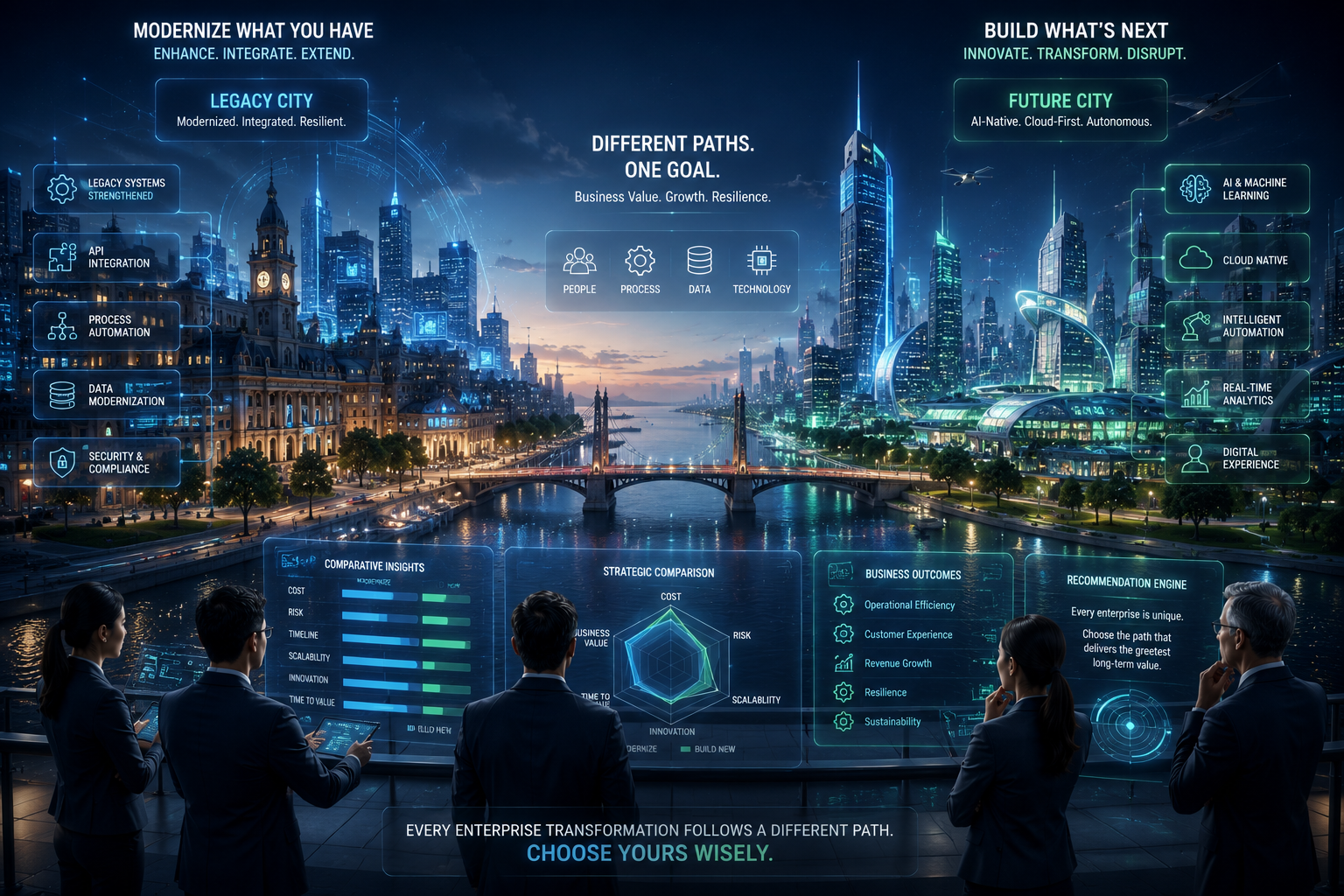
A system is causing pain, and the enterprise IT team faces a decision that gets framed, more often than not, as a false binary: rebuild it from scratch, or modernise what already exists. In practice, these are two distinct strategies with different starting points, different risk profiles, and different circumstances in which each is the right call – and the wrong choice at this fork routinely costs enterprises months of misdirected effort.
This post draws a precise line between bespoke development and legacy modernization, explains when each is the right strategy, and sets out how enterprises that need elements of both can sequence them without duplicating effort.
Defining the Terms
What Is Legacy Modernization?
Legacy modernisation starts from an existing system and transforms it – through rehosting, refactoring, re-platforming, or rebuilding – while preserving the business logic and institutional knowledge embedded in the current application. The starting point is what already exists, even when the strategy chosen is a full re-engineering.
Modernisation is the right frame when the existing system’s business logic remains valid, and the problem is the architecture, technology stack, or scalability constraints it is built on.
What Is Bespoke Development?
Bespoke development starts with a blank slate – or the closest thing to one – and builds a new application shaped entirely around current and future business requirements, without being constrained by an existing system’s data model, architecture, or accumulated assumptions.
Bespoke development is the right frame when the business process itself needs to change substantially, when no existing system provides a credible foundation, or when the opportunity to build without legacy constraints outweighs the value of preserving what currently exists.
Why Enterprises Conflate the Two
The confusion arises because both strategies can produce the same category of outcome – a modern, scalable, AI-ready application – and both are frequently delivered by the same technology partner under a single transformation programme. It becomes tempting to treat them as interchangeable labels for “we’re fixing the old system,” when the actual approach taken has significant implications for cost, risk, and timeline.
A rebuild-strategy legacy modernisation and a full bespoke development project can look identical on a slide. They are not identical in execution – modernisation carries forward validated business logic and reduces requirements risk; bespoke development starts from open requirements and carries higher discovery risk but removes any constraint from the old system’s assumptions.
Side-by-Side Comparison
| Dimension | Legacy Modernization (Rebuild) | Bespoke Development |
|---|---|---|
| Starting point | Existing system and business logic | Business requirements, open slate |
| Primary objective | Preserve validated logic on modern architecture | Build capability shaped by current & future needs |
| Requirements risk | Lower – logic already validated in production | Higher – requires full discovery |
| Typical timeline | 6-24 months depending on scope | 3-18 months depending on scope |
| Best suited to | Systems whose logic remains valid, architecture doesn’t | Processes with no adequate existing foundation |
| Change management need | Moderate – users already know the process | Higher – new process, new interface, new habits |
| Long-term flexibility | Bound to preserved business logic | Unconstrained by legacy assumptions |
The table illustrates the core tradeoff: modernisation carries forward validated logic at the cost of some inherited constraint, while bespoke development removes constraint at the cost of full requirements discovery. Neither is universally better – the right choice depends on whether the existing logic is an asset worth preserving or a liability worth leaving behind.
When to Modernize, When to Build New, and When to Do Both
Choose legacy modernization when:
- The current business logic is well understood, validated by years of production use, and still fit for purpose.
- The problem is clearly architectural – scalability, integration, maintainability – rather than a fundamental mismatch with business needs.
- Preserving continuity of the existing user experience and process is valuable to the business.
Choose bespoke development when:
- The business process itself needs to change substantially, not just the technology underneath it.
- No existing system provides a credible foundation, or the existing system’s assumptions actively conflict with where the business needs to go.
- The opportunity cost of being constrained by legacy data models and logic outweighs the value of what currently exists.
Choose both – in sequence – when:
- Some modules of a legacy estate have valid logic worth modernising, while others need to be replaced with purpose-built new capability.
- A broader transformation programme includes both rebuilding constrained legacy components and building genuinely new capability alongside them.
- You need to stabilise the existing estate through modernisation before committing engineering resource to a larger custom build.
The Phased Roadmap: Sequencing Both Without Duplication
Phase 1: System-by-System Classification (3-5 weeks)
Assess each system or module in scope and classify it: modernise, replace with bespoke development, or leave as-is. This classification should be based on whether the existing business logic remains valid, not on the age of the technology alone.
Phase 2: Modernization Track (as scoped per system)
Execute modernisation for systems whose logic is worth preserving, following the appropriate strategy – rehost, refactor, re-platform, or rebuild – for each.
Phase 3: Bespoke Development Track (as scoped per capability)
Run discovery and build for genuinely new capability in parallel, sequenced so that integration points between modernised systems and new bespoke applications are defined early rather than discovered late.
Phase 4: Integration and Continuous Evolution (ongoing)
Once both tracks reach production, maintain a unified view of the resulting application estate – modernised and bespoke systems together – and continue to evolve both as business requirements change.
Common Pitfalls
- Defaulting to rebuild out of habit – choosing a full bespoke rebuild for a system whose business logic was actually sound, discarding validated institutional knowledge unnecessarily.
- Modernising logic that should have been replaced – carrying forward business rules that no longer reflect how the business actually wants to operate, simply because they exist in the old system.
- Running both tracks without a shared integration plan – modernised systems and new bespoke applications that were scoped independently and don’t connect cleanly when both reach production.
The Bottom Line
Legacy modernisation and bespoke development are not competing labels for the same activity – they start from different premises and carry different risk profiles. The right starting point is a clear-eyed classification of what you already have: is the business logic an asset worth carrying forward, or a constraint worth leaving behind?
For enterprises facing this decision across a broader estate, the answer is rarely all-one-or-all-the-other. It is a system-by-system classification, sequenced into a single coherent transformation roadmap.
Related Services
Not sure whether your application should be modernized or rebuilt? Contact SMI TechSolutions to evaluate the best approach for your business and create a transformation roadmap tailored to your goals.