




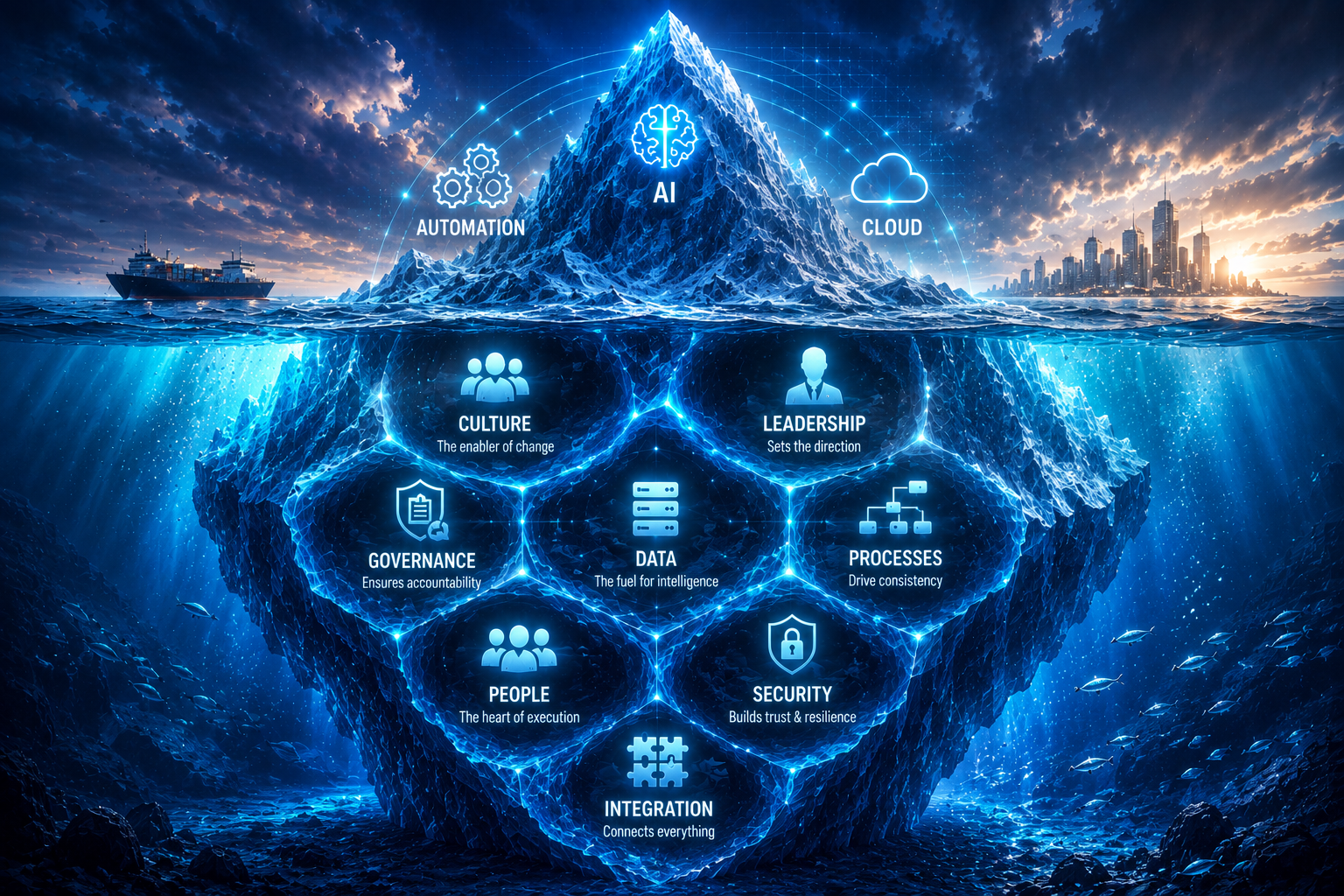
Few terms in enterprise technology have been stretched thinner than “digital transformation.” It has been used to describe a new website, a cloud migration, an ERP upgrade, and a genuine reinvention of how a business operates and competes – often within the same organisation, in the same year. That elasticity has made the term easy to dismiss as marketing language, which is unfortunate, because the underlying idea is real and consequential.
Digital transformation, properly defined, is not a technology project. It is a change to how an organisation creates value, enabled by technology – and it is distinct from simply modernising a system or building a new application, even though it frequently involves both.
This guide sets out what digital transformation actually means, the core pillars that make up a genuine transformation programme, how to prioritise where to start, and how to build a business case that survives board scrutiny.
What Is Digital Transformation?
Digital transformation is the process of fundamentally changing how an organisation operates, delivers value to customers, and competes in its market, using digital technology as the enabling force – not the end goal. It is distinguished from a technology upgrade by the scope of what changes: not just the tools a team uses, but the processes, operating model, and in many cases the business model itself.
A useful test: if a technology initiative could succeed completely – on time, on budget, fully adopted – and the organisation would still operate, compete, and serve customers in fundamentally the same way it did before, it was a technology upgrade, not a digital transformation. Genuine transformation changes the shape of the business, not just the systems underneath it.
This is why digital transformation programmes routinely involve legacy modernization and bespoke development as components – but succeeding at either does not, by itself, constitute transformation. The technology work enables the change; it is not the change.
Signs Your Organisation Needs Digital Transformation, Not Just a Tech Upgrade
Before committing to a transformation programme, leadership needs clarity on whether the organisation’s challenge is a technology gap or a genuine strategic and operating model problem. These signals point to the latter:
- Customer expectations have shifted structurally – customers now expect digital-first, self-service, or real-time experiences that the current operating model cannot deliver regardless of which systems support it.
- Competitors are changing the basis of competition – new entrants or incumbents are competing on data, speed, or personalisation in ways the current business model was not designed to match.
- Process redesign keeps stalling on organisational boundaries – improvement initiatives repeatedly hit walls at departmental handoffs, because the processes were designed around organisational structure rather than customer or operational outcomes.
- Technology investment isn’t translating into business results – the organisation has made significant technology investments, but customer and financial outcomes haven’t moved, because the surrounding processes and incentives haven’t changed alongside the technology.
- Data exists but isn’t driving decisions – the organisation has invested in analytics capability, but decision-making at the point of action remains manual, intuition-driven, and disconnected from available data.
If three or more of these apply, the challenge extends beyond any single system or process – it calls for a coordinated transformation programme, not an isolated technology project.
The Five Pillars of Digital Transformation
Digital transformation is not a single initiative – it is a coordinated set of changes across five interconnected dimensions. Enterprises rarely need to advance all five at the same pace, but a genuine transformation programme addresses all of them deliberately, rather than leaving some to chance.
1. Customer Experience Transformation
Redesign how customers discover, engage with, and are served by the organisation – across digital and human channels – based on what customers actually need at each stage, not on how internal departments happen to be organised.
Best for: organisations where customer expectations have outpaced the current experience, and where competitive differentiation increasingly depends on experience quality rather than product alone.
2. Operating Model and Process Redesign
Redesign core operating processes around end-to-end outcomes rather than departmental handoffs – removing the coordination overhead, delay, and error introduced every time work crosses an organisational boundary.
Best for: organisations where internal process friction is the primary constraint on speed, cost, or quality, regardless of the technology already in place.
3. Technology and Data Foundation
Establish the modernised systems, integrated data platform, and AI capability that make the other four pillars achievable – this is where Legacy Modernization, Bespoke Development, and Data Modernisation programmes typically sit within a broader transformation.
Best for: organisations whose current technology estate cannot support the process and experience changes the transformation requires.
4. Culture and Organisational Capability
Build the skills, incentives, and decision-making norms that allow the organisation to operate the redesigned processes and use the new technology as intended – rather than reverting to old habits once the initial change management push ends.
Best for: organisations where previous technology or process initiatives delivered the intended capability but failed to achieve lasting adoption.
5. Business Model Innovation
Reconsider how the organisation creates and captures value – new revenue models, new channels, new partnerships – made possible by the technology, data, and operating model changes underway. Not every transformation programme needs this pillar, but the most ambitious ones use transformation as an opportunity to rethink the business model itself.
Best for: organisations facing structural competitive pressure, where incremental improvement to the existing model is insufficient to maintain market position.
How to Prioritise: Choosing Where to Start
Few enterprises can advance all five pillars simultaneously at full pace. The decision comes down to four questions:
- Where is the competitive or customer pressure most acute? This typically determines whether customer experience or operating model redesign should lead the programme.
- What technology gaps are blocking every other pillar? If the data and systems foundation cannot support process or experience change, that foundation needs to be addressed first, even if it isn’t the most visible pillar.
- How much organisational change capacity exists right now? Culture and capability building takes sustained leadership attention – overloading the organisation with simultaneous change initiatives increases the risk that none of them stick.
- What is the realistic timeline for board and market expectations? A full five-pillar transformation is a multi-year programme; sequencing early, visible wins builds the credibility needed to sustain longer-term pillars.
Most successful transformation programmes sequence the technology and data foundation early – since it enables the other pillars – while running visible, customer-facing improvements in parallel to demonstrate momentum and secure continued investment.
Building a Business Case for Digital Transformation
Digital transformation business cases fail most often not because the ambition is wrong, but because the value is described too broadly to be measured. An effective business case addresses four categories with specific, attributable metrics:
- Revenue growth – new channels, improved conversion, and expanded customer lifetime value attributable to specific experience and business model changes.
- Cost efficiency – process redesign and automation that reduce the cost of specific, named operations, not a general efficiency assumption.
- Competitive resilience – the cost of inaction, quantified against the specific competitive or market shift the organisation is responding to.
- Organisational capability – the compounding value of a workforce and culture equipped to sustain continuous change, which is harder to quantify but real over a multi-year horizon.
Anchor each category to specific, named initiatives with owners and timelines – a business case built on “digital transformation will improve efficiency” survives scrutiny far worse than one built on “redesigning the claims process will reduce processing cost by a stated percentage within a defined timeframe.”
Digital Transformation Readiness Checklist
- Executive sponsor identified with cross-functional authority – not just budget for one department.
- Current-state technology, process, and experience gaps mapped across all five pillars.
- Specific, named initiatives selected for the first phase, tied to measurable business outcomes.
- Change management and capability-building resourced as a core workstream, not an afterthought.
- Success metrics agreed in writing, attributable to specific initiatives rather than the programme as a whole.
- Governance structure that spans business and technology leadership, meeting on a defined cadence.
Why Enterprises Choose SMI for Digital Transformation
SMI TECHSOLUTIONS delivers digital transformation programmes under outcome-driven engagement models, coordinating the legacy modernisation, bespoke development, data engineering, and Gen AI capabilities that make genuine transformation achievable – rather than treating each as an isolated project.
Our AI-native engineering approach accelerates the technology and data foundation work that most transformation programmes depend on, while our embedded delivery teams carry accountability for the business outcomes the programme is built to achieve – not just the technology milestones along the way.
Whether you are defining a transformation roadmap or ready to sequence a specific pillar, our transformation specialists are available to discuss your situation with no commitment required.
Related Services
- Digital Transformation
- Legacy Modernization
- Bespoke Development
- Data Modernisation
- Generative AI Services
Ready to accelerate your digital transformation journey? Contact SMI TechSolutions to discuss a transformation roadmap tailored to your business objectives.