




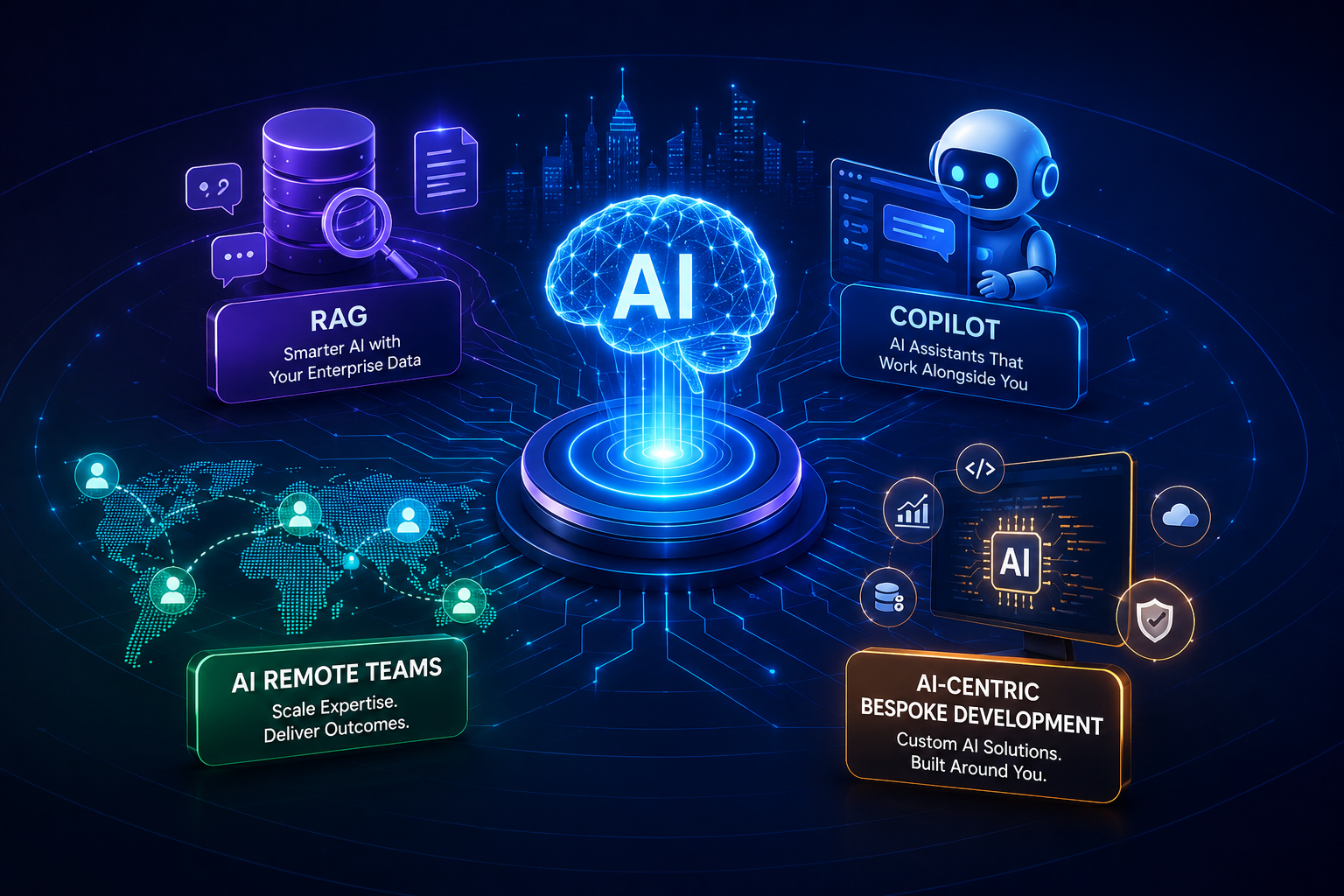
“We need a Gen AI strategy” is a sentence heard in nearly every enterprise boardroom now – and it routinely means four different things depending on who is saying it. To one leader, it means employees need better access to internal knowledge. To another, it means AI assistance embedded in existing tools. To a third, it means augmenting the engineering team’s capacity. To a fourth, it means a genuinely new AI-native application. These are not variations on one initiative – they are four distinct service models, each solving a different problem.
This guide maps the four Gen AI service models enterprises are investing in today, explains what each one actually delivers, and sets out how to choose the right one – or combination – for your specific need.
The Four Gen AI Service Models
Enterprise Gen AI investment tends to fall into four distinct categories. Understanding the boundaries between them prevents the common mistake of commissioning one model while expecting the outcomes of another.
1. RAG (Knowledge-Based AI)
Retrieval-Augmented Generation grounds an AI model’s responses in your organisation’s own documents, policies, and data – rather than relying solely on the model’s general training. A RAG system retrieves the most relevant internal content for a given query and feeds it to the model alongside the question, producing answers grounded in your actual institutional knowledge rather than generic or outdated information.
Best for: enterprises where employees or customers need fast, accurate answers drawn from internal documentation, policies, or product knowledge that changes frequently and would quickly go stale if baked into a model directly.
2. Copilot
A Copilot is an AI assistant embedded directly into an existing workflow or application – a coding environment, a CRM, a document editor – designed to accelerate a specific task rather than operate as a standalone chatbot. The defining characteristic of a Copilot is context: it sees what the user is working on and offers relevant, in-the-moment assistance rather than requiring the user to switch tools and re-explain their situation.
Best for: enterprises that want to accelerate productivity within tools employees already use daily, rather than introducing a separate AI interface people need to remember to open.
3. AI Remote Team
An AI Remote Team is a flexible delivery model that combines skilled engineering and operations specialists with AI-native tooling and practices, delivered as an extension of your team rather than a fixed in-house hire. This model gives enterprises access to AI-accelerated delivery capacity without the lead time, cost, and risk of building an internal AI engineering function from scratch.
Best for: enterprises that need to scale delivery capacity for a defined initiative or ongoing programme without committing to permanent headcount, particularly where AI-native development practices would meaningfully accelerate the work.
4. AI-Centric Bespoke Development
AI-Centric Bespoke Development is custom application development built AI-native from the ground up – not a traditional application with AI features added later, but software architected from day one around AI capability: data structures designed for retrieval and model consumption, workflows designed for human-AI collaboration, and interfaces designed around AI-assisted tasks.
Best for: enterprises building a genuinely new capability where AI is core to the value proposition, not a bolt-on feature – and where a conventional application architecture would constrain what the AI capability can eventually do.
How to Choose the Right Gen AI Service Model
The decision comes down to four questions:
- What problem are you actually solving? Knowledge access points to RAG. Workflow acceleration points to Copilot. Delivery capacity points to an AI Remote Team. A genuinely new AI-native product points to bespoke development.
- Does the capability need to live inside an existing tool, or stand alone? Copilot integrates into existing workflows; RAG can power either a standalone knowledge tool or be embedded into a Copilot experience.
- Is the constraint capacity, or capability you don’t have in-house at all? An AI Remote Team addresses a capacity gap in a team that already has direction. Bespoke development addresses the absence of the capability itself.
- How mature is your existing data and knowledge foundation? RAG and Copilot both depend on the quality of the underlying data and documentation – a poor foundation limits the value of either, regardless of which you choose.
Many enterprises combine models rather than choosing one exclusively – a RAG-powered knowledge base embedded as a Copilot inside a customer service tool, delivered by an AI Remote Team, is a common and effective combination rather than four separate decisions.
Building a Business Case for Enterprise Gen AI Services
Gen AI investment is most effectively justified against the specific problem each service model solves, not a general appeal to AI adoption. An effective business case addresses:
- Time-to-answer or time-to-resolution – for RAG and Copilot investments, the quantifiable reduction in time employees or customers spend searching for information or completing a task.
- Delivery capacity and speed – for AI Remote Team engagements, the cost and timeline comparison against hiring, and the acceleration AI-native practices bring to the specific programme.
- New capability value – for bespoke AI-centric development, the revenue or competitive value of a capability that could not be achieved by adding AI features to an existing application.
Anchor each business case to the specific service model and the specific problem it solves – a business case that tries to justify all four models under one generic “AI transformation” umbrella will struggle to demonstrate attributable value for any of them.
Gen AI Services Readiness Checklist
- The specific problem is clearly identified – knowledge access, workflow acceleration, delivery capacity, or new capability.
- Underlying data and documentation quality assessed, particularly for RAG and Copilot investments.
- Success metrics agreed in writing, specific to the chosen service model.
- Governance and human-in-the-loop requirements defined for any AI system with production access.
- Ownership assigned for maintaining and evolving the capability after initial delivery.
Why Enterprises Choose SMI for Gen AI Services
SMI TECHSOLUTIONS delivers all four Gen AI service models under outcome-driven engagement models – RAG-powered knowledge systems, embedded Copilot experiences, AI Remote Team delivery capacity, and fully AI-centric bespoke applications – built on the same governed data foundation our broader data engineering practice establishes.
We help enterprises identify which model – or combination – actually solves their specific problem, rather than defaulting to whichever is most fashionable, and we carry delivery accountability through to measurable business outcomes.
Whether you need better knowledge access, embedded productivity tools, additional AI-native delivery capacity, or a genuinely new AI-first application, our specialists are available to discuss your situation with no commitment required.
Related Services
Looking to identify the right Gen AI approach for your enterprise? Contact SMI TechSolutions to discuss the right Gen AI service model or combination for your business.